- Sort Score
- Num 10 results
- Language All
Results 1301 - 1310 of 1,468 for example1 (0.06 seconds)
-
android/guava-tests/test/com/google/common/collect/OrderingTest.java
  }

  // From https://github.com/google/guava/issues/1342
  public void testComplicatedOrderingExample() {
    Integer nullInt = (Integer) null;
    Ordering<@Nullable Iterable<@Nullable Integer>> example =
        Ordering.<Integer>natural()
            .<Integer>nullsFirst()
            .<@Nullable Integer>reverse()
            .<@Nullable Integer>lexicographical()
            .reverse()
Created: Fri Dec 26 12:43:10 GMT 2025 - Last Modified: Fri Oct 10 23:13:45 GMT 2025 - 42.8K bytes - Click Count (0) -
android/guava/src/com/google/common/collect/CompactHashMap.java
  //
  // The `table` array always has a size that is a power of 2. The hashcode of a key in the map
  // is masked in order to correspond to the current table size. For example, if the table size
  // is 128 then the mask is 127 == 0x7f, keeping the bottom 7 bits of the hash value.
  // If a key hashes to 0x89abcdef the mask reduces it to 0x89abcdef & 0x7f == 0x6f. We'll call this
  // the "short hash".
Created: Fri Dec 26 12:43:10 GMT 2025 - Last Modified: Sat Aug 09 01:14:59 GMT 2025 - 35.7K bytes - Click Count (0) -
guava-tests/test/com/google/common/collect/OrderingTest.java
  }

  // From https://github.com/google/guava/issues/1342
  public void testComplicatedOrderingExample() {
    Integer nullInt = (Integer) null;
    Ordering<@Nullable Iterable<@Nullable Integer>> example =
        Ordering.<Integer>natural()
            .<Integer>nullsFirst()
            .<@Nullable Integer>reverse()
            .<@Nullable Integer>lexicographical()
            .reverse()
Created: Fri Dec 26 12:43:10 GMT 2025 - Last Modified: Fri Oct 10 23:13:45 GMT 2025 - 42.8K bytes - Click Count (0) -
guava/src/com/google/common/io/BaseEncoding.java
 * strings. This class includes several constants for encoding schemes specified by <a
 * href="http://tools.ietf.org/html/rfc4648">RFC 4648</a>. For example, the expression:
 *
 * {@snippet :
 * BaseEncoding.base32().encode("foo".getBytes(US_ASCII))
 * }
 *
 * <p>returns the string {@code "MZXW6==="}, and
 *
 * {@snippet :
Created: Fri Dec 26 12:43:10 GMT 2025 - Last Modified: Mon Oct 06 14:51:47 GMT 2025 - 41.7K bytes - Click Count (0) -
guava/src/com/google/common/collect/ImmutableList.java
    int size = size();
    for (int i = 0; i < size; i++) {
      dst[offset + i] = get(i);
    }
    return offset + size;
  }

  /**
   * Returns a view of this immutable list in reverse order. For example, {@code ImmutableList.of(1,
   * 2, 3).reverse()} is equivalent to {@code ImmutableList.of(3, 2, 1)}.
   *
   * @return a view of this immutable list in reverse order
   * @since 7.0
   */
Created: Fri Dec 26 12:43:10 GMT 2025 - Last Modified: Mon Nov 17 22:50:48 GMT 2025 - 30.6K bytes - Click Count (0) -
fastapi/_compat/v2.py
    "alias": None,
    "alias_priority": None,
    "validation_alias": None,
    "serialization_alias": None,
    "title": None,
    "field_title_generator": None,
    "description": None,
    "examples": None,
    "exclude": None,
    "exclude_if": None,
    "discriminator": None,
    "deprecated": None,
    "json_schema_extra": None,
    "frozen": None,
    "validate_default": None,
    "repr": True,
Created: Sun Dec 28 07:19:09 GMT 2025 - Last Modified: Sat Dec 27 12:54:56 GMT 2025 - 19.1K bytes - Click Count (0) -
android/guava/src/com/google/common/collect/Iterables.java
    return FluentIterable.concat(inputs);
  }

  /**
   * Divides an iterable into unmodifiable sublists of the given size (the final iterable may be
   * smaller). For example, partitioning an iterable containing {@code [a, b, c, d, e]} with a
   * partition size of 3 yields {@code [[a, b, c], [d, e]]} -- an outer iterable containing two
   * inner lists of three and two elements, all in the original order.
Created: Fri Dec 26 12:43:10 GMT 2025 - Last Modified: Tue Sep 16 18:35:28 GMT 2025 - 43.8K bytes - Click Count (0) -
android/guava-tests/benchmark/com/google/common/util/concurrent/MonitorBasedPriorityBlockingQueue.java
 * priority. If you need to enforce an ordering, you can define custom classes or comparators that
 * use a secondary key to break ties in primary priority values. For example, here is a class that
 * applies first-in-first-out tie-breaking to comparable elements. To use it, you would insert a
 * {@code new FIFOEntry(anEntry)} instead of a plain entry object.
 *
 * <pre>{@code
Created: Fri Dec 26 12:43:10 GMT 2025 - Last Modified: Tue May 13 18:46:00 GMT 2025 - 18.9K bytes - Click Count (0) -
docs/fr/docs/features.md
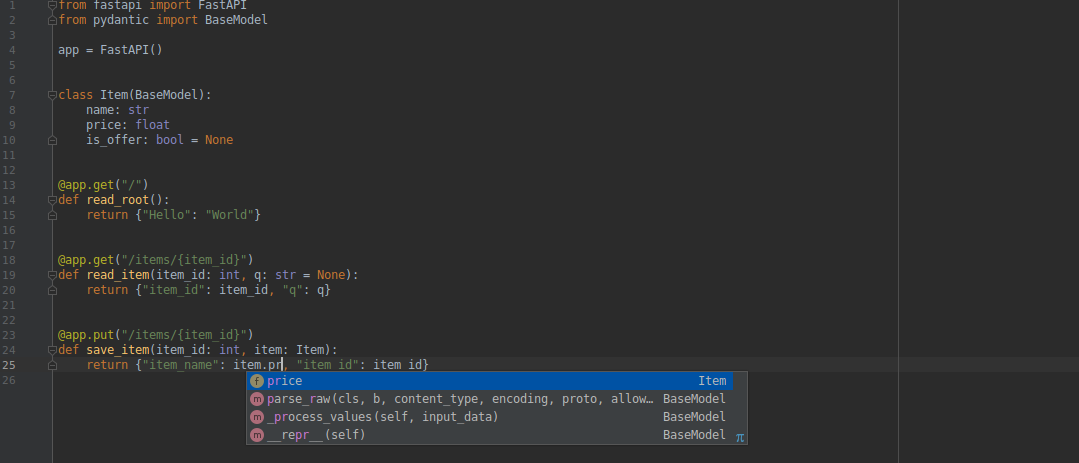 Vous aurez des propositions de complétion que vous n'auriez jamais imaginées. Par exemple la clé `prix` dans le corps d'un document JSON (qui est peut-être imbriqué) venant d'une requête.
Created: Sun Dec 28 07:19:09 GMT 2025 - Last Modified: Sat Oct 11 17:48:49 GMT 2025 - 11.1K bytes - Click Count (0) -
guava/src/com/google/common/base/Functions.java
   * NullPointerException} on null input.
   *
   * <p><b>Warning:</b> The returned function may not be <i>consistent with equals</i> (as
   * documented at {@link Function#apply}). For example, this function yields different results for
   * the two equal instances {@code ImmutableSet.of(1, 2)} and {@code ImmutableSet.of(2, 1)}.
   *
Created: Fri Dec 26 12:43:10 GMT 2025 - Last Modified: Wed Aug 06 17:32:30 GMT 2025 - 15.4K bytes - Click Count (0)