- Sort Score
- Result 10 results
- Languages All
Results 101 - 110 of 1,948 for fastapi (1.41 sec)
-
docs/en/docs/reference/dependencies.md
Dependencies are handled mainly with the special function `Depends()` that takes a callable.

Here is the reference for it and its parameters.

You can import it directly from `fastapi`:

```python
from fastapi import Depends
```

::: fastapi.Depends

## `Security()`

For many scenarios, you can handle security (authorization, authentication, etc.) with dependencies, using `Depends()`.
Registered: Sun Dec 28 07:19:09 UTC 2025 - Last Modified: Thu Apr 18 19:53:19 UTC 2024 - 671 bytes - Viewed (0) -
tests/test_security_api_key_cookie_description.py
from fastapi import Depends, FastAPI, Security
from fastapi.security import APIKeyCookie
from fastapi.testclient import TestClient
from pydantic import BaseModel

app = FastAPI()

api_key = APIKeyCookie(name="key", description="An API Cookie Key")


class User(BaseModel):
    username: str


def get_current_user(oauth_header: str = Security(api_key)):
    user = User(username=oauth_header)
    return user
Registered: Sun Dec 28 07:19:09 UTC 2025 - Last Modified: Mon Nov 24 19:03:06 UTC 2025 - 2.1K bytes - Viewed (0) -
tests/test_security_http_bearer_optional.py
from typing import Optional

from fastapi import FastAPI, Security
from fastapi.security import HTTPAuthorizationCredentials, HTTPBearer
from fastapi.testclient import TestClient

app = FastAPI()

security = HTTPBearer(auto_error=False)


@app.get("/users/me")
def read_current_user(
    credentials: Optional[HTTPAuthorizationCredentials] = Security(security),
):
    if credentials is None:
Registered: Sun Dec 28 07:19:09 UTC 2025 - Last Modified: Fri Jun 30 18:25:16 UTC 2023 - 2.1K bytes - Viewed (0) -
tests/test_security_oauth2_authorization_code_bearer_description.py
from typing import Optional

from fastapi import FastAPI, Security
from fastapi.security import OAuth2AuthorizationCodeBearer
from fastapi.testclient import TestClient

app = FastAPI()

oauth2_scheme = OAuth2AuthorizationCodeBearer(
    authorizationUrl="authorize",
    tokenUrl="token",
    description="OAuth2 Code Bearer",
    auto_error=True,
)


@app.get("/items/")
Registered: Sun Dec 28 07:19:09 UTC 2025 - Last Modified: Fri Jun 30 18:25:16 UTC 2023 - 2.4K bytes - Viewed (0) -
tests/test_security_oauth2_password_bearer_optional.py
from typing import Optional

from fastapi import FastAPI, Security
from fastapi.security import OAuth2PasswordBearer
from fastapi.testclient import TestClient

app = FastAPI()

oauth2_scheme = OAuth2PasswordBearer(tokenUrl="/token", auto_error=False)


@app.get("/items/")
async def read_items(token: Optional[str] = Security(oauth2_scheme)):
    if token is None:
        return {"msg": "Create an account first"}
    return {"token": token}
Registered: Sun Dec 28 07:19:09 UTC 2025 - Last Modified: Fri Jun 30 18:25:16 UTC 2023 - 2.1K bytes - Viewed (0) -
docs/es/docs/alternatives.md
Considero a **FastAPI** un "sucesor espiritual" de APIStar, mientras mejora y aumenta las funcionalidades, el sistema de tipos y otras partes, basándose en los aprendizajes de todas estas herramientas previas.

///

## Usado por **FastAPI** { #used-by-fastapi }
Registered: Sun Dec 28 07:19:09 UTC 2025 - Last Modified: Wed Dec 17 10:15:01 UTC 2025 - 25.9K bytes - Viewed (0) -
docs/pt/docs/alternatives.md
Eu considero o **FastAPI** um "sucessor espiritual" do APIStar, enquanto aprimora e amplia as funcionalidades, o sistema de tipagem e outras partes, baseado nos aprendizados de todas essas ferramentas anteriores.

///

## Usados por **FastAPI** { #used-by-fastapi }
Registered: Sun Dec 28 07:19:09 UTC 2025 - Last Modified: Wed Nov 12 16:23:57 UTC 2025 - 25.9K bytes - Viewed (0) -
docs/uk/docs/features.md
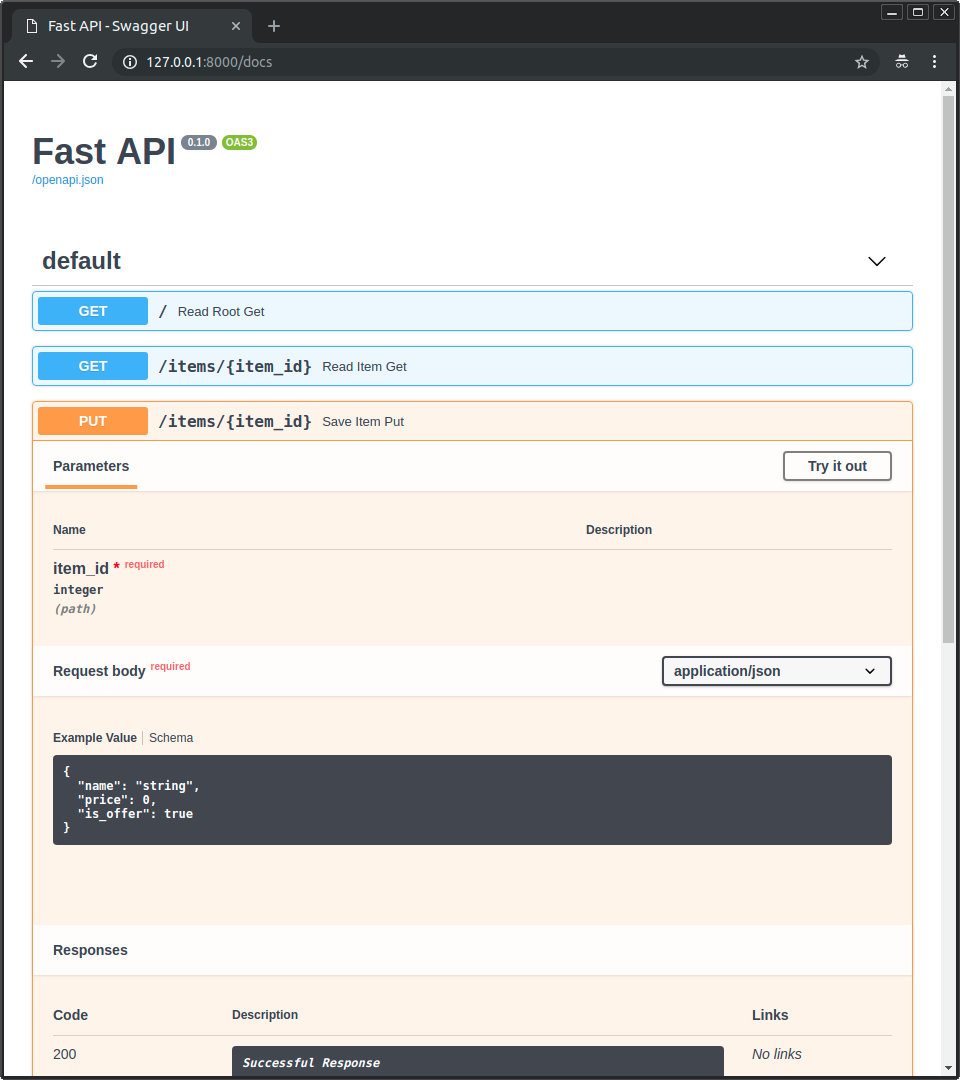 * Альтернативна документація API за допомогою <a href="https://github.com/Rebilly/ReDoc" class="external-link" target="_blank"><strong>ReDoc</strong></a>. 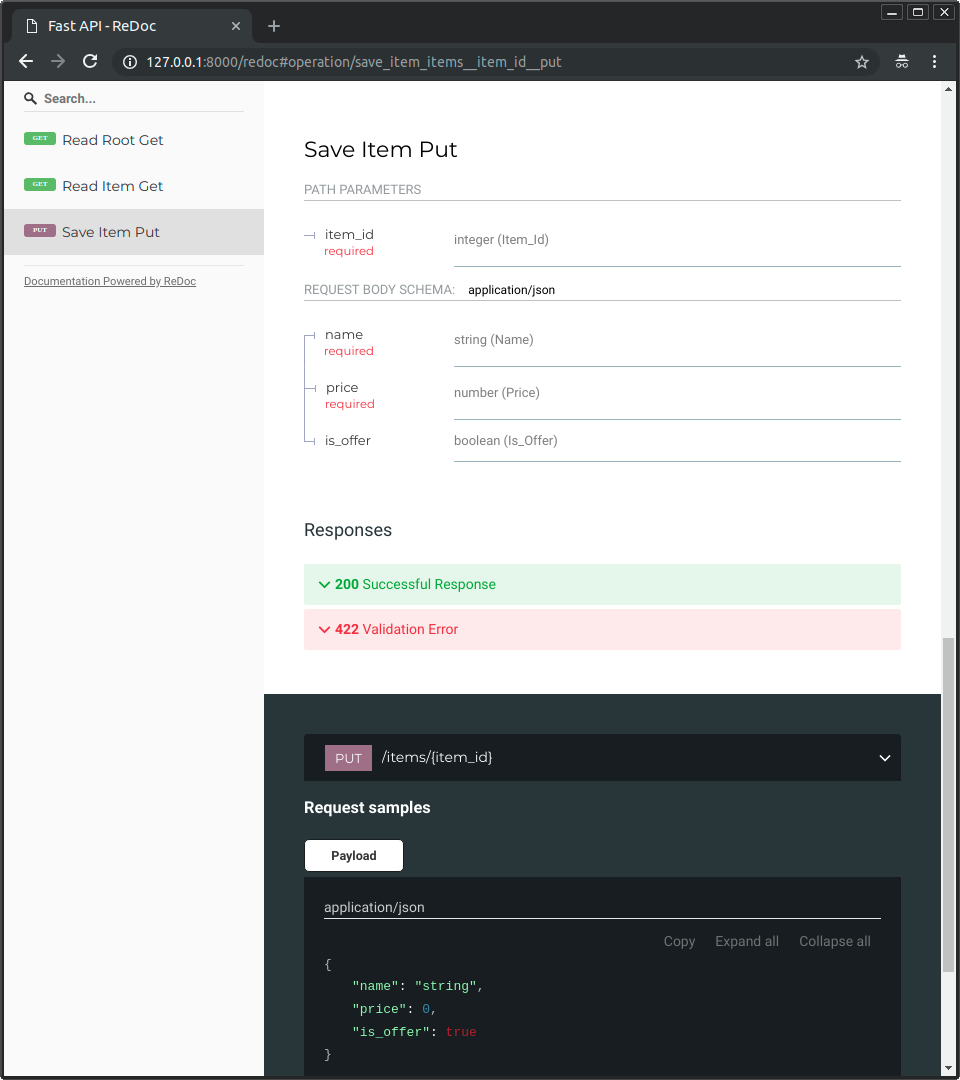 ### Тільки сучасний Python
Registered: Sun Dec 28 07:19:09 UTC 2025 - Last Modified: Sat Oct 11 17:48:49 UTC 2025 - 14.3K bytes - Viewed (0) -
docs/es/docs/tutorial/dependencies/classes-as-dependencies.md
Registered: Sun Dec 28 07:19:09 UTC 2025 - Last Modified: Wed Dec 17 20:41:43 UTC 2025 - 7.1K bytes - Viewed (0) -
docs_src/custom_request_and_route/tutorial002_an_py310.py
from collections.abc import Callable
from typing import Annotated

from fastapi import Body, FastAPI, HTTPException, Request, Response
from fastapi.exceptions import RequestValidationError
from fastapi.routing import APIRoute


class ValidationErrorLoggingRoute(APIRoute):
    def get_route_handler(self) -> Callable:
        original_route_handler = super().get_route_handler()

        async def custom_route_handler(request: Request) -> Response:
Registered: Sun Dec 28 07:19:09 UTC 2025 - Last Modified: Wed Dec 10 08:55:32 UTC 2025 - 974 bytes - Viewed (0)