- Sort Score
- Result 10 results
- Languages All
Results 1 - 9 of 9 for recap (0.02 sec)
-
docs/de/docs/tutorial/body-updates.md
Wie in `stored_item_model.model_copy(update=update_data)`:

{* ../../docs_src/body_updates/tutorial002_py310.py hl[33] *}

### Rekapitulation zu Teil-Aktualisierungen { #partial-updates-recap }

Zusammengefasst, um Teil-Aktualisierungen vorzunehmen:

* (Optional) verwenden Sie `PATCH` statt `PUT`.
* Lesen Sie die bereits gespeicherten Daten aus.
* Fügen Sie diese in ein Pydantic-Modell ein.
Registered: Sun Dec 28 07:19:09 UTC 2025 - Last Modified: Wed Dec 24 10:28:19 UTC 2025 - 5.1K bytes - Viewed (0) -
docs/de/llm-prompt.md
* «the header parameter»: «der Header-Parameter»
* «the form parameter»: «der Formular-Parameter»
* «the payload»: «die Payload»
* «the performance»: NOT «die Performance»
* «the query»: «die Query»
* «the recap»: «die Zusammenfassung»
* «the request» (what the client sends to the server): «der Request»
* «the request body»: «der Requestbody»
* «the request bodies» (plural): «die Requestbodys»
Registered: Sun Dec 28 07:19:09 UTC 2025 - Last Modified: Fri Dec 26 09:39:53 UTC 2025 - 11.9K bytes - Viewed (0) -
docs/de/docs/tutorial/extra-models.md
Registered: Sun Dec 28 07:19:09 UTC 2025 - Last Modified: Wed Dec 24 10:28:19 UTC 2025 - 8K bytes - Viewed (0) -
docs/de/docs/advanced/settings.md
## Zusammenfassung { #recap }

Mit Pydantic Settings können Sie die Einstellungen oder Konfigurationen für Ihre Anwendung verwalten und dabei die gesamte Leistungsfähigkeit der Pydantic-Modelle nutzen.
Registered: Sun Dec 28 07:19:09 UTC 2025 - Last Modified: Wed Dec 24 10:28:19 UTC 2025 - 13.1K bytes - Viewed (0) -
docs/en/docs/index.md
* The alternative documentation will also reflect the new query parameter and body: 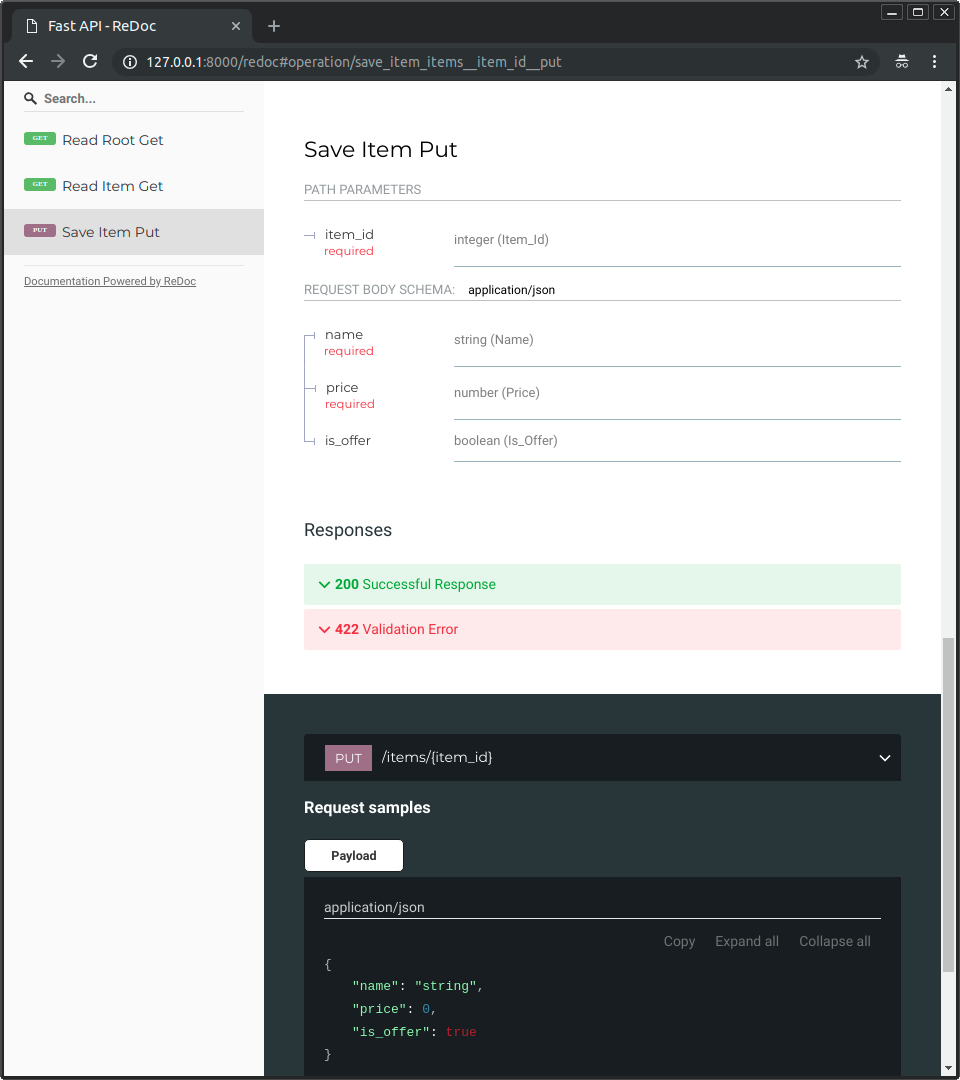 ### Recap { #recap } In summary, you declare **once** the types of parameters, body, etc. as function parameters. You do that with standard modern Python types.Registered: Sun Dec 28 07:19:09 UTC 2025 - Last Modified: Thu Dec 25 11:01:37 UTC 2025 - 23.5K bytes - Viewed (0) -
docs/de/docs/tutorial/response-model.md
{* ../../docs_src/response_model/tutorial006_py310.py hl[29,35] *}

## Zusammenfassung { #recap }

Verwenden Sie den Parameter `response_model` im *Pfadoperation-Dekorator*, um Responsemodelle zu definieren, und besonders, um private Daten herauszufiltern.
Registered: Sun Dec 28 07:19:09 UTC 2025 - Last Modified: Wed Dec 24 10:28:19 UTC 2025 - 17.5K bytes - Viewed (0) -
docs/de/docs/index.md
* Die alternative Dokumentation wird ebenfalls den neuen Query-Parameter und Body widerspiegeln:  ### Zusammenfassung { #recap } Zusammengefasst deklarieren Sie **einmal** die Typen von Parametern, Body, usw. als Funktionsparameter. Das machen Sie mit modernen Standard-Python-Typen.Registered: Sun Dec 28 07:19:09 UTC 2025 - Last Modified: Fri Dec 26 09:39:53 UTC 2025 - 25.8K bytes - Viewed (0) -
docs/de/docs/tutorial/query-params-str-validations.md
... wir tun all dies in einer **einzelnen einfachen Zeile**. 🤯 Lieben Sie nicht auch Python? 🐍

{* ../../docs_src/query_params_str_validations/tutorial015_an_py310.py ln[22:30] hl[29] *}

## Zusammenfassung { #recap }

Sie können zusätzliche Validierungen und Metadaten für Ihre Parameter deklarieren.

Allgemeine Validierungen und Metadaten:

* `alias`
* `title`
* `description`
* `deprecated`
Registered: Sun Dec 28 07:19:09 UTC 2025 - Last Modified: Wed Dec 24 10:28:19 UTC 2025 - 19.1K bytes - Viewed (0) -
README.md
* The alternative documentation will also reflect the new query parameter and body:  ### Recap In summary, you declare **once** the types of parameters, body, etc. as function parameters. You do that with standard modern Python types.
Registered: Sun Dec 28 07:19:09 UTC 2025 - Last Modified: Thu Dec 25 11:01:37 UTC 2025 - 26.4K bytes - Viewed (0)