- Sort Score
- Num 10 results
- Language All
Results 21 - 30 of 1,128 for _parameters (0.06 seconds)
The search processing time has exceeded the limit. The displayed results may be partial.
-
docs/de/docs/tutorial/header-params.md
# Header-Parameter { #header-parameters }

Sie können Header-Parameter genauso definieren, wie Sie `Query`-, `Path`- und `Cookie`-Parameter definieren.

## `Header` importieren { #import-header }

Importieren Sie zuerst `Header`:

{* ../../docs_src/header_params/tutorial001_an_py310.py hl[3] *}

## `Header`-Parameter deklarieren { #declare-header-parameters }
Created: Sun Apr 05 07:19:11 GMT 2026 - Last Modified: Sat Sep 20 15:10:09 GMT 2025 - 3.5K bytes - Click Count (0) -
src/main/java/org/codelibs/fess/mylasta/action/FessMessages.java
    /**
     * Add the created action message for the key 'constraints.Size.message' with parameters.
     * <pre>
     * message: The size of {item} must be between {min} and {max}.
     * </pre>
     * @param property The property name for the message. (NotNull)
     * @param min The parameter min for message. (NotNull)
     * @param max The parameter max for message. (NotNull)
     * @return this. (NotNull)
     */
Created: Tue Mar 31 13:07:34 GMT 2026 - Last Modified: Sat Mar 28 06:59:19 GMT 2026 - 126.6K bytes - Click Count (0) -
docs/en/docs/tutorial/header-param-models.md
# Header Parameter Models { #header-parameter-models }

If you have a group of related **header parameters**, you can create a **Pydantic model** to declare them.

This would allow you to **re-use the model** in **multiple places** and also to declare validations and metadata for all the parameters at once. 😎

/// note

This is supported since FastAPI version `0.115.0`. 🤓

///
Created: Sun Apr 05 07:19:11 GMT 2026 - Last Modified: Sun Aug 31 09:15:41 GMT 2025 - 2.6K bytes - Click Count (0) -
src/main/java/org/codelibs/fess/app/web/go/GoForm.java
    // for error page

    /**
     * Query string parameter for error page fallback.
     * Contains the original search query if redirection fails.
     */
    public String q;

    /**
     * Number of results parameter for error page fallback.
     * Specifies how many results to display if redirection fails.
     */
    public String num;

    /**
     * Sort parameter for error page fallback.
Created: Tue Mar 31 13:07:34 GMT 2026 - Last Modified: Thu Jul 17 08:28:31 GMT 2025 - 2.9K bytes - Click Count (0) -
docs/fr/docs/tutorial/path-params.md
# Paramètres de chemin { #path-parameters }

Vous pouvez déclarer des « paramètres » ou « variables » de chemin avec la même syntaxe utilisée par les chaînes de format Python :

{* ../../docs_src/path_params/tutorial001_py310.py hl[6:7] *}

La valeur du paramètre de chemin `item_id` sera transmise à votre fonction dans l'argument `item_id`.
Created: Sun Apr 05 07:19:11 GMT 2026 - Last Modified: Thu Mar 19 18:37:13 GMT 2026 - 10.1K bytes - Click Count (0) -
docs/en/docs/tutorial/request-files.md
///

/// tip

To declare File bodies, you need to use `File`, because otherwise the parameters would be interpreted as query parameters or body (JSON) parameters.

///

The files will be uploaded as "form data".

If you declare the type of your *path operation function* parameter as `bytes`, **FastAPI** will read the file for you and you will receive the contents as `bytes`.
Created: Sun Apr 05 07:19:11 GMT 2026 - Last Modified: Thu Mar 05 18:13:19 GMT 2026 - 7K bytes - Click Count (0) -
guava/src/com/google/common/base/Preconditions.java
    }
  }

  /*
   * Preconditions.checkNotNull is *intended* for performing eager null checks on parameters that a
   * nullness checker can already "prove" are non-null. That means that the first parameter to
   * checkNotNull *should* be annotated to require it to be non-null.
   *
   * However, for a variety of reasons, Google developers have written a ton of code over the past
Created: Fri Apr 03 12:43:13 GMT 2026 - Last Modified: Thu Jan 08 18:10:02 GMT 2026 - 53.5K bytes - Click Count (0) -
compat/maven-plugin-api/src/main/java/org/apache/maven/plugin/descriptor/MojoDescriptor.java
    public void setParameters(List<Parameter> parameters) throws DuplicateParameterException {
        this.parameters.clear();
        for (Parameter parameter : parameters) {
            addParameter(parameter);
        }
    }

    /**
     * @param parameter add a new parameter
     * @throws DuplicateParameterException if any
     */
    public void addParameter(Parameter parameter) throws DuplicateParameterException {
Created: Sun Apr 05 03:35:12 GMT 2026 - Last Modified: Fri Jun 06 14:28:57 GMT 2025 - 21.7K bytes - Click Count (0) -
README.md
* The alternative documentation will also reflect the new query parameter and body: 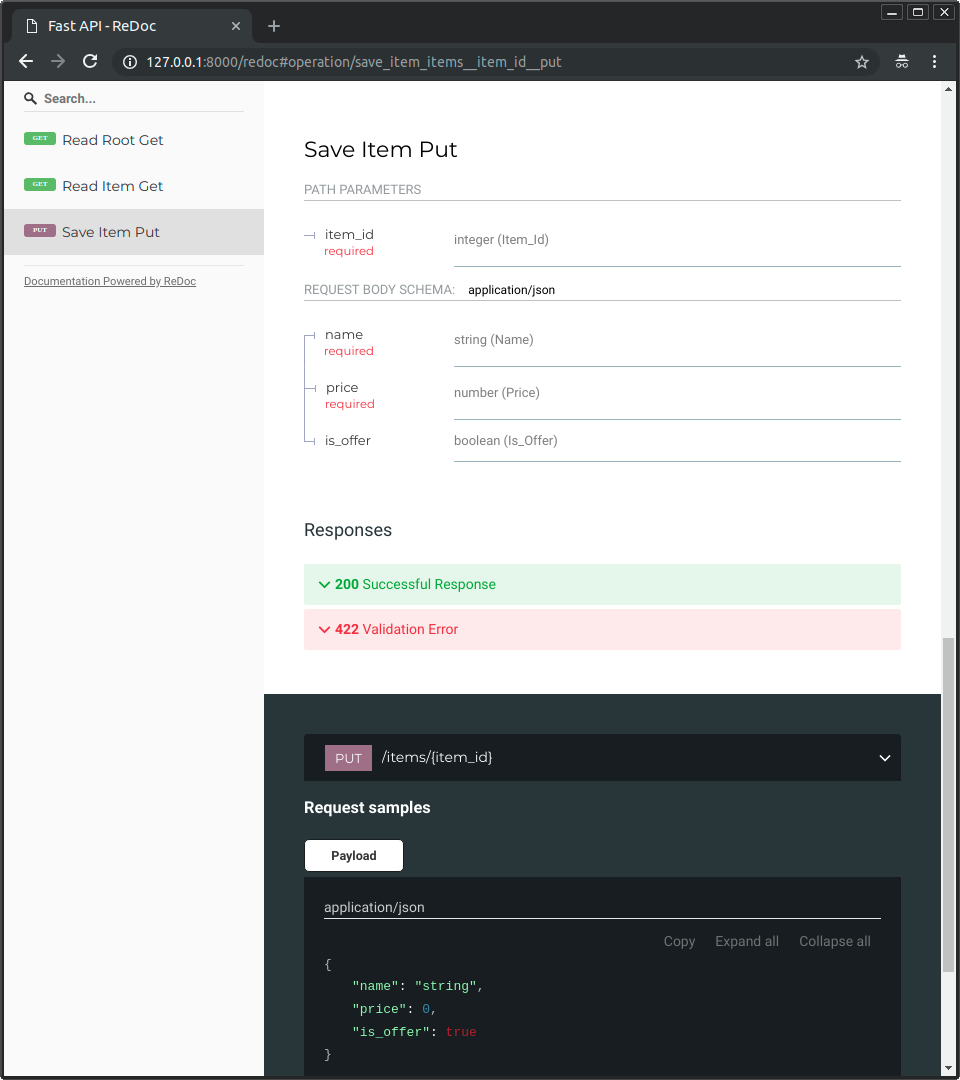 ### Recap In summary, you declare **once** the types of parameters, body, etc. as function parameters. You do that with standard modern Python types.
Created: Sun Apr 05 07:19:11 GMT 2026 - Last Modified: Sat Mar 07 09:29:03 GMT 2026 - 24.3K bytes - Click Count (0) -
docs/en/docs/tutorial/path-operation-configuration.md
# Path Operation Configuration { #path-operation-configuration }

There are several parameters that you can pass to your *path operation decorator* to configure it.

/// warning

Notice that these parameters are passed directly to the *path operation decorator*, not to your *path operation function*.

///

## Response Status Code { #response-status-code }

You can define the (HTTP) `status_code` to be used in the response of your *path operation*.
Created: Sun Apr 05 07:19:11 GMT 2026 - Last Modified: Thu Mar 05 18:13:19 GMT 2026 - 4K bytes - Click Count (0)