- Sort Score
- Num 10 results
- Language All
Results 371 - 380 of over 10,000 for http (0.03 seconds)
-
helm-releases/minio-3.3.3.tgz
9000 --namespace {{ .Release.Namespace }} Read more about port forwarding here: http://kubernetes.io/docs/user-guide/kubectl/kubectl_port-forward/ You can now access MinIO server on http://localhost:9000. Follow the below steps to connect to MinIO server with mc client: 1. Download the MinIO mc client - https://docs.minio.io/docs/minio-client-quickstart-guide 2. export MC_HOST_{{ template "minio.fullname" . }}-local=http://$(kubectl get secret {{ template "minio.secretName" . }} -o jsonpath="{.data.rootUser}"...Created: Sun Apr 05 19:28:12 GMT 2026 - Last Modified: Sat Dec 11 17:28:02 GMT 2021 - 14.6K bytes - Click Count (0) -
okhttp/src/commonJvmAndroid/kotlin/okhttp3/internal/http2/Settings.kt
  }

  companion object {
    /**
     * From the HTTP/2 specs, the default initial window size for all streams is 64 KiB. (Chrome 25
     * uses 10 MiB).
     */
    const val DEFAULT_INITIAL_WINDOW_SIZE = 65535

    /** HTTP/2: Size in bytes of the table used to decode the sender's header blocks. */
    const val HEADER_TABLE_SIZE = 1

    /** HTTP/2: The peer must not send a PUSH_PROMISE frame when this is 0. */
Created: Fri Apr 03 11:42:14 GMT 2026 - Last Modified: Fri Dec 27 13:39:56 GMT 2024 - 3.8K bytes - Click Count (0) -
helm-releases/minio-3.4.7.tgz
9000 --namespace {{ .Release.Namespace }} Read more about port forwarding here: http://kubernetes.io/docs/user-guide/kubectl/kubectl_port-forward/ You can now access MinIO server on http://localhost:9000. Follow the below steps to connect to MinIO server with mc client: 1. Download the MinIO mc client - https://docs.minio.io/docs/minio-client-quickstart-guide 2. export MC_HOST_{{ template "minio.fullname" . }}-local=http://$(kubectl get secret --namespace {{ .Release.Namespace }} {{ template "minio.secretName"...Created: Sun Apr 05 19:28:12 GMT 2026 - Last Modified: Tue Jan 25 20:49:24 GMT 2022 - 15.2K bytes - Click Count (0) -
docs/uk/docs/tutorial/first-steps.md
Тепер перейдіть сюди [http://127.0.0.1:8000/docs](http://127.0.0.1:8000/docs). Ви побачите автоматичну інтерактивну API документацію (надається [Swagger UI](https://github.com/swagger-api/swagger-ui)): 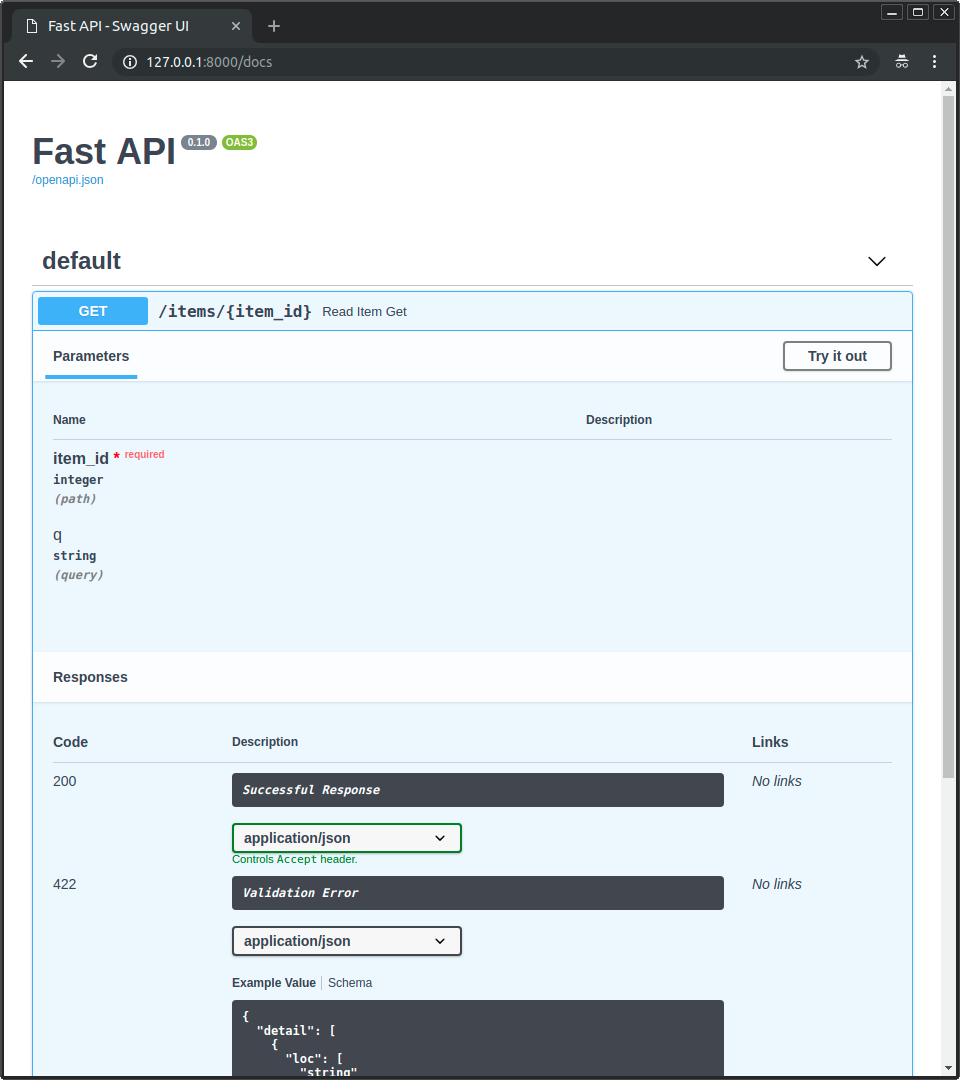 ### Альтернативна API документація { #alternative-api-docs } А тепер перейдіть сюди [http://127.0.0.1:8000/redoc](http://127.0.0.1:8000/redoc).Created: Sun Apr 05 07:19:11 GMT 2026 - Last Modified: Thu Mar 19 18:27:41 GMT 2026 - 18.7K bytes - Click Count (0) -
apache-maven/src/assembly/maven/conf/settings.xml
      <name>Human Readable Name for this Mirror.</name>
      <url>http://my.repository.com/repo/path</url>
    </mirror>
    -->
    <mirror>
      <id>maven-default-http-blocker</id>
      <mirrorOf>external:http:*</mirrorOf>
      <name>Pseudo repository to mirror external repositories initially using HTTP.</name>
      <url>http://0.0.0.0/</url>
      <blocked>true</blocked>
    </mirror>
  </mirrors>
Created: Sun Apr 05 03:35:12 GMT 2026 - Last Modified: Wed Jan 22 07:44:50 GMT 2025 - 11.1K bytes - Click Count (0) -
compat/maven-model-builder/src/test/resources/poms/validation/bad-repository-id.xml
    <repository>
      <id>this/is\bad</id>
      <url>http://localhost</url>
    </repository>
  </repositories>
  <pluginRepositories>
    <pluginRepository>
      <id>this/is\bad</id>
      <url>http://localhost</url>
    </pluginRepository>
  </pluginRepositories>

  <distributionManagement>
    <repository>
      <id>this/is\bad</id>
      <url>http://localhost</url>
    </repository>
    <snapshotRepository>
Created: Sun Apr 05 03:35:12 GMT 2026 - Last Modified: Fri Oct 25 12:31:46 GMT 2024 - 1.4K bytes - Click Count (0) -
README.md
 - [Gitbucket](https://github.com/codelibs/fess-ds-gitbucket)
 - [G Suite](https://github.com/codelibs/fess-ds-gsuite)
 - [JSON](https://github.com/codelibs/fess-ds-json)
 - [Office 365](https://github.com/codelibs/fess-ds-office365)
 - [S3](https://github.com/codelibs/fess-ds-s3)
 - [Salesforce](https://github.com/codelibs/fess-ds-salesforce)
 - [SharePoint](https://github.com/codelibs/fess-ds-sharepoint)
Created: Tue Mar 31 13:07:34 GMT 2026 - Last Modified: Sat Feb 14 03:19:23 GMT 2026 - 7.8K bytes - Click Count (2) -
okhttp/src/commonJvmAndroid/kotlin/okhttp3/internal/http2/ErrorCode.kt
 * See the License for the specific language governing permissions and
 * limitations under the License.
 */
package okhttp3.internal.http2

/** http://tools.ietf.org/html/draft-ietf-httpbis-http2-17#section-7 */
enum class ErrorCode constructor(
  val httpCode: Int,
) {
  /** Not an error!  */
  NO_ERROR(0),

  PROTOCOL_ERROR(1),

  INTERNAL_ERROR(2),

  FLOW_CONTROL_ERROR(3),
Created: Fri Apr 03 11:42:14 GMT 2026 - Last Modified: Wed Mar 19 19:25:20 GMT 2025 - 1.2K bytes - Click Count (0) -
okhttp/src/jvmTest/kotlin/okhttp3/WebPlatformUrlTestData.kt
 *
 * Each line of the `urltestdata.txt` file specifies a test. Lines look like this:
 *
 * ```
 * http://example\t.\norg http://example.org/foo/bar s:http h:example.org p:/
 * ```
 */
class WebPlatformUrlTestData {
  var input: String? = null
  var base: String? = null
  var scheme = ""
  var username = ""
  var password: String? = null
  var host = ""
  var port = ""
  var path = ""
Created: Fri Apr 03 11:42:14 GMT 2026 - Last Modified: Wed Mar 19 19:25:20 GMT 2025 - 3.7K bytes - Click Count (0) -
docs/bucket/replication/setup_2site_existing_replication.sh
minio server --address 127.0.0.1:9003 "http://127.0.0.1:9003/tmp/multisiteb/data/disterasure/xl{1...4}" \
	"http://127.0.0.1:9004/tmp/multisiteb/data/disterasure/xl{5...8}" >/tmp/siteb_1.log 2>&1 &
minio server --address 127.0.0.1:9004 "http://127.0.0.1:9003/tmp/multisiteb/data/disterasure/xl{1...4}" \
	"http://127.0.0.1:9004/tmp/multisiteb/data/disterasure/xl{5...8}" >/tmp/siteb_2.log 2>&1 &
Created: Sun Apr 05 19:28:12 GMT 2026 - Last Modified: Fri Sep 06 09:42:21 GMT 2024 - 5.6K bytes - Click Count (0)