- Sort Score
- Num 10 results
- Language All
Results 301 - 310 of 482 for redeclare (0.16 seconds)
-
android/guava/src/com/google/common/collect/ObjectArrays.java
   * @param reference any array of the desired type
   * @param length the length of the new array
   */
  /*
   * The new array contains nulls, even if the old array did not. If we wanted to be accurate, we
   * would declare a return type of `@Nullable T[]`. However, we've decided not to think too hard
   * about arrays for now, as they're a mess.
   */
  public static <T extends @Nullable Object> T[] newArray(T[] reference, int length) {
Created: Fri Apr 03 12:43:13 GMT 2026 - Last Modified: Fri Jan 23 17:16:53 GMT 2026 - 9.2K bytes - Click Count (0) -
docs/uk/docs/tutorial/path-params.md
Якщо вам цікаво, «AlexNet», «ResNet» та «LeNet» — це просто назви моделей машинного навчання <dfn title="Технічно, архітектури моделей глибокого навчання">моделі</dfn>.

///

### Оголосіть *параметр шляху* { #declare-a-path-parameter }

Потім створіть *параметр шляху* з анотацією типу, використовуючи створений вами клас enum (`ModelName`):

{* ../../docs_src/path_params/tutorial005_py310.py hl[16] *}
Created: Sun Apr 05 07:19:11 GMT 2026 - Last Modified: Thu Mar 19 18:27:41 GMT 2026 - 14K bytes - Click Count (0) -
docs/uk/docs/tutorial/schema-extra-example.md
# Декларування прикладів вхідних даних { #declare-request-example-data }

Ви можете задати приклади даних, які ваш застосунок може отримувати.

Ось кілька способів, як це зробити.

## Додаткові дані Схеми JSON у моделях Pydantic { #extra-json-schema-data-in-pydantic-models }

Ви можете задати `examples` для моделі Pydantic, які буде додано до згенерованої Схеми JSON.

{* ../../docs_src/schema_extra_example/tutorial001_py310.py hl[13:24] *}
Created: Sun Apr 05 07:19:11 GMT 2026 - Last Modified: Thu Mar 19 18:27:41 GMT 2026 - 13.3K bytes - Click Count (0) -
docs/ko/docs/tutorial/body.md
    "tax": 3.5
}
```

...`description`과 `tax`는 (기본 값이 `None`으로 되어 있어) 선택적이기 때문에, 이 JSON "`object`"는 다음과 같은 상황에서도 유효합니다:

```JSON
{
    "name": "Foo",
    "price": 45.2
}
```

## 매개변수로서 선언하기 { #declare-it-as-a-parameter }

여러분의 *경로 처리*에 추가하기 위해, 경로 매개변수 그리고 쿼리 매개변수에서 선언했던 것과 같은 방식으로 선언하면 됩니다.

{* ../../docs_src/body/tutorial001_py310.py hl[16] *}

...그리고 만들어낸 모델인 `Item`으로 타입을 선언합니다.

## 결과 { #results }
Created: Sun Apr 05 07:19:11 GMT 2026 - Last Modified: Fri Mar 20 14:06:26 GMT 2026 - 8K bytes - Click Count (0) -
docs/en/docs/index.md
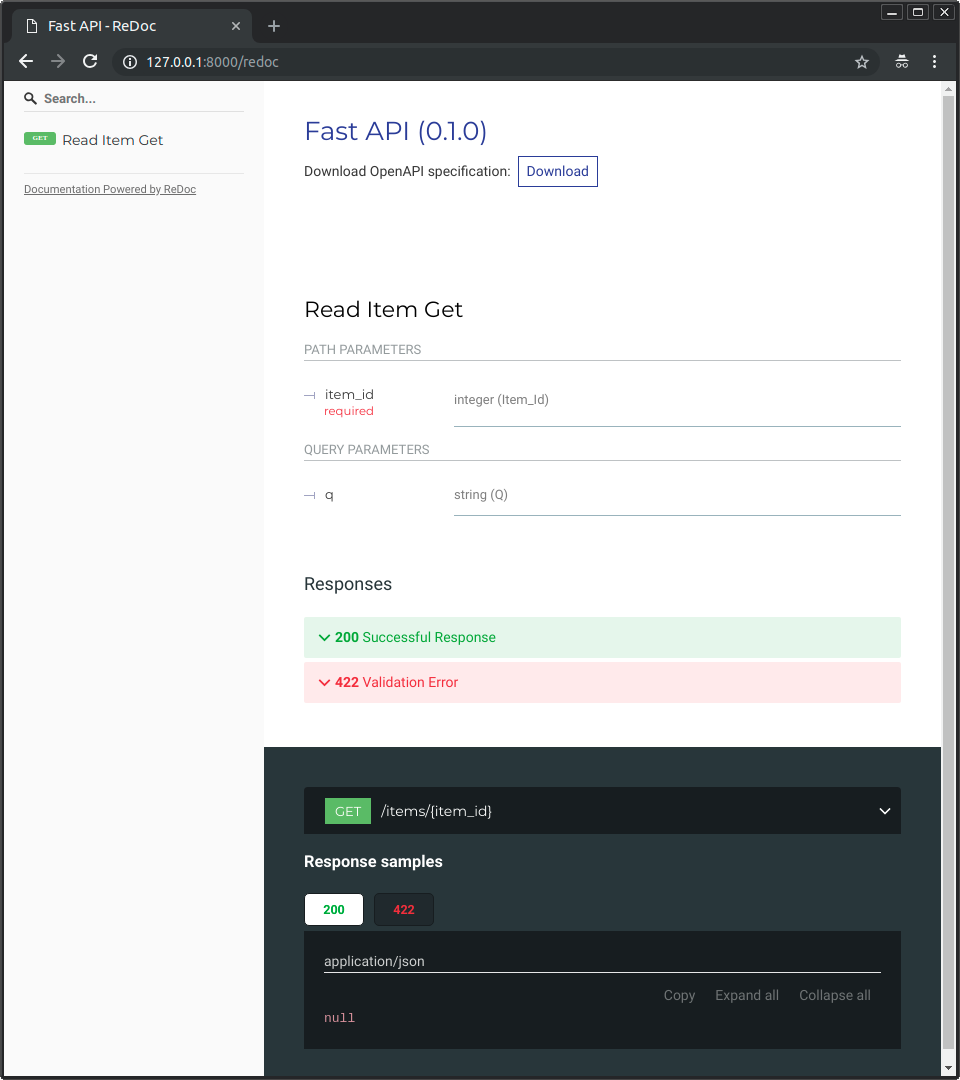 ## Example upgrade { #example-upgrade } Now modify the file `main.py` to receive a body from a `PUT` request. Declare the body using standard Python types, thanks to Pydantic. ```Python hl_lines="2 7-10 23-25" from fastapi import FastAPI from pydantic import BaseModel app = FastAPI() class Item(BaseModel):Created: Sun Apr 05 07:19:11 GMT 2026 - Last Modified: Sat Mar 07 09:29:03 GMT 2026 - 21.4K bytes - Click Count (0) -
docs/ru/docs/advanced/security/oauth2-scopes.md
///

{* ../../docs_src/security/tutorial005_an_py310.py hl[157] *}

## Объявление scopes в *обработчиках путей* и зависимостях { #declare-scopes-in-path-operations-and-dependencies }

Теперь объявим, что операция пути для `/users/me/items/` требует scope `items`.

Для этого импортируем и используем `Security` из `fastapi`.
Created: Sun Apr 05 07:19:11 GMT 2026 - Last Modified: Thu Mar 19 17:56:20 GMT 2026 - 20.6K bytes - Click Count (0) -
docs/de/docs/tutorial/dependencies/index.md
### `Depends` importieren { #import-depends }

{* ../../docs_src/dependencies/tutorial001_an_py310.py hl[3] *}

### Die Abhängigkeit im <abbr title="Das Abhängige, der Verwender der Abhängigkeit">„Dependant“</abbr> deklarieren { #declare-the-dependency-in-the-dependant }

So wie auch `Body`, `Query`, usw., verwenden Sie `Depends` mit den Parametern Ihrer *Pfadoperation-Funktion*:

{* ../../docs_src/dependencies/tutorial001_an_py310.py hl[13,18] *}
Created: Sun Apr 05 07:19:11 GMT 2026 - Last Modified: Thu Mar 19 17:58:09 GMT 2026 - 11.3K bytes - Click Count (0) -
docs/en/docs/features.md
Created: Sun Apr 05 07:19:11 GMT 2026 - Last Modified: Thu Mar 05 18:13:19 GMT 2026 - 8.9K bytes - Click Count (0) -
docs/pt/docs/features.md
Você escreve Python padrão com tipos:

```Python
from datetime import date

from pydantic import BaseModel

# Declare uma variável como str
# e obtenha suporte do editor dentro da função
def main(user_id: str):
    return user_id


# Um modelo do Pydantic
class User(BaseModel):
    id: int
    name: str
    joined: date
Created: Sun Apr 05 07:19:11 GMT 2026 - Last Modified: Thu Mar 19 18:20:43 GMT 2026 - 10.1K bytes - Click Count (0) -
docs/en/docs/advanced/settings.md
</div>

### Create the `Settings` object { #create-the-settings-object }

Import `BaseSettings` from Pydantic and create a sub-class, very much like with a Pydantic model.

The same way as with Pydantic models, you declare class attributes with type annotations, and possibly default values.

You can use all the same validation features and tools you use for Pydantic models, like different data types and additional validations with `Field()`.
Created: Sun Apr 05 07:19:11 GMT 2026 - Last Modified: Thu Mar 05 18:13:19 GMT 2026 - 10.9K bytes - Click Count (0)