- Sort Score
- Result 10 results
- Languages All
Results 241 - 250 of 338 for declarou (0.05 sec)
-
android/guava-testlib/src/com/google/common/collect/testing/testers/NavigableSetNavigationTester.java
   * FeatureSpecificTestSuiteBuilder.suppressing()}.
   */
  /*
   * TODO(cpovirk): or we could make HOLES_FORBIDDEN a feature. Or we could declare that
   * implementations are permitted to throw IAE if a hole is requested, and we could update
   * test*Hole to permit IAE. (But might this ignore genuine bugs?) But see the TODO above
Registered: Fri Dec 26 12:43:10 UTC 2025 - Last Modified: Thu Nov 14 23:40:07 UTC 2024 - 8.5K bytes - Viewed (0) -
docs/en/docs/async.md
<abbr title="too long; didn't read"><strong>TL;DR:</strong></abbr>

If you are using third party libraries that tell you to call them with `await`, like:

```Python
results = await some_library()
```

Then, declare your *path operation functions* with `async def` like:

```Python hl_lines="2"
@app.get('/')
async def read_results():
    results = await some_library()
    return results
```

/// note
Registered: Sun Dec 28 07:19:09 UTC 2025 - Last Modified: Sun Aug 31 09:56:21 UTC 2025 - 24K bytes - Viewed (0) -
docs/de/docs/tutorial/body-nested-models.md
## Listen mit Typ-Parametern als Felder { #list-fields-with-type-parameter }

Aber Python erlaubt es, Listen mit inneren Typen, auch „Typ-Parameter“ genannt, zu deklarieren.

### Eine `list` mit einem Typ-Parameter deklarieren { #declare-a-list-with-a-type-parameter }

Um Typen zu deklarieren, die Typ-Parameter (innere Typen) haben, wie `list`, `dict`, `tuple`, übergeben Sie den/die inneren Typ(en) als „Typ-Parameter“ in eckigen Klammern: `[` und `]`

```Python
Registered: Sun Dec 28 07:19:09 UTC 2025 - Last Modified: Wed Dec 17 20:41:43 UTC 2025 - 7.6K bytes - Viewed (0) -
docs/es/docs/features.md
Registered: Sun Dec 28 07:19:09 UTC 2025 - Last Modified: Wed Dec 17 10:15:01 UTC 2025 - 10.8K bytes - Viewed (0) -
docs/en/docs/tutorial/cors.md
In this case, the list would have to include `http://localhost:8080` for the `:8080`-frontend to work correctly.

## Wildcards { #wildcards }

It's also possible to declare the list as `"*"` (a "wildcard") to say that all are allowed.
Registered: Sun Dec 28 07:19:09 UTC 2025 - Last Modified: Wed Dec 17 20:41:43 UTC 2025 - 5.5K bytes - Viewed (0) -
guava/src/com/google/common/collect/ComparisonChain.java
  }

  /**
   * Compares two comparable objects as specified by {@link Comparable#compareTo}, <i>if</i> the
   * result of this comparison chain has not already been determined.
   *
   * <p>This method is declared to accept any 2 {@code Comparable} objects, even if they are not <a
   * href="https://docs.oracle.com/javase/tutorial/collections/interfaces/order.html">mutually
Registered: Fri Dec 26 12:43:10 UTC 2025 - Last Modified: Mon Mar 17 20:26:29 UTC 2025 - 11.1K bytes - Viewed (0) -
impl/maven-core/src/main/java/org/apache/maven/plugin/internal/DefaultPluginValidationManager.java
Registered: Sun Dec 28 03:35:09 UTC 2025 - Last Modified: Sat Apr 05 11:52:32 UTC 2025 - 17.5K bytes - Viewed (0) -
docs/es/docs/tutorial/dependencies/dependencies-with-yield.md
Si no se especifica y la dependencia tiene `yield`, tendrá un `scope` de `"request"` por defecto.

### `scope` para sub-dependencias { #scope-for-sub-dependencies }

Cuando declaras una dependencia con `scope="request"` (el valor por defecto), cualquier sub-dependencia también necesita tener un `scope` de `"request"`.
Registered: Sun Dec 28 07:19:09 UTC 2025 - Last Modified: Wed Dec 17 20:41:43 UTC 2025 - 13.7K bytes - Viewed (0) -
docs/en/docs/advanced/settings.md
Next it will convert and validate the data. So, when you use that `settings` object, you will have data of the types you declared (e.g. `items_per_user` will be an `int`).

### Use the `settings` { #use-the-settings }

Then you can use the new `settings` object in your application:

{* ../../docs_src/settings/tutorial001_py39.py hl[18:20] *}
Registered: Sun Dec 28 07:19:09 UTC 2025 - Last Modified: Sat Dec 20 15:55:38 UTC 2025 - 11.2K bytes - Viewed (0) -
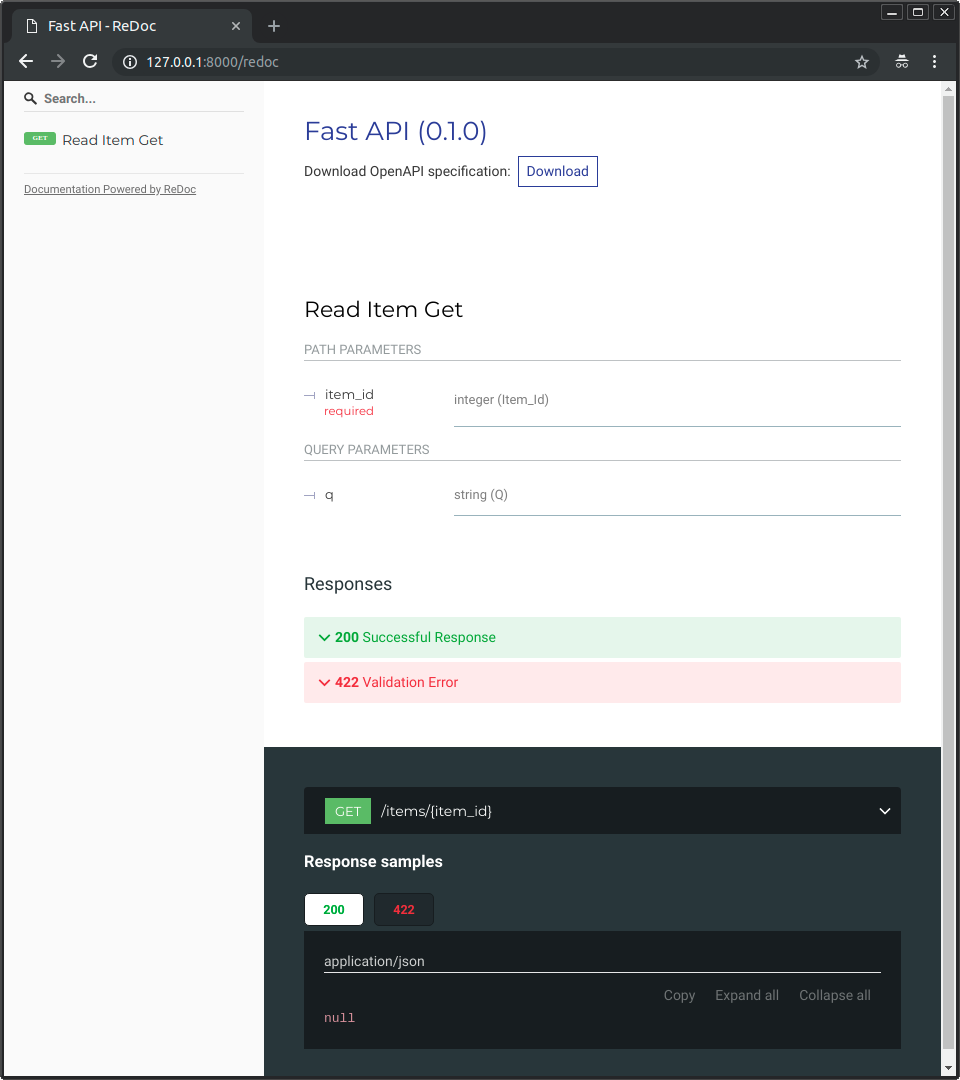
docs/pt/docs/index.md
 ## Evoluindo o Exemplo { #example-upgrade } Agora modifique o arquivo `main.py` para receber um corpo para uma requisição `PUT`. Declare o corpo utilizando tipos padrão Python, graças ao Pydantic. ```Python hl_lines="4 9-12 25-27" from typing import Union from fastapi import FastAPI from pydantic import BaseModel app = FastAPI()Registered: Sun Dec 28 07:19:09 UTC 2025 - Last Modified: Tue Dec 16 20:32:40 UTC 2025 - 24.5K bytes - Viewed (0)