- Sort Score
- Num 10 results
- Language All
Results 71 - 80 of 80 for Races (0.02 seconds)
-
docs/es/docs/tutorial/security/simple-oauth2.md
  "email": "******@****.***",
  "full_name": "John Doe",
  "disabled": false,
  "hashed_password": "fakehashedsecret"
}
```

<img src="/img/tutorial/security/image06.png">

Si haces clic en el icono de candado y cierras sesión, y luego intentas la misma operación nuevamente, obtendrás un error HTTP 401 de:

```JSON
{
  "detail": "Not authenticated"
}
```
Created: Sun Apr 05 07:19:11 GMT 2026 - Last Modified: Thu Mar 19 18:15:55 GMT 2026 - 10.2K bytes - Click Count (0) -
docs/es/docs/index.md
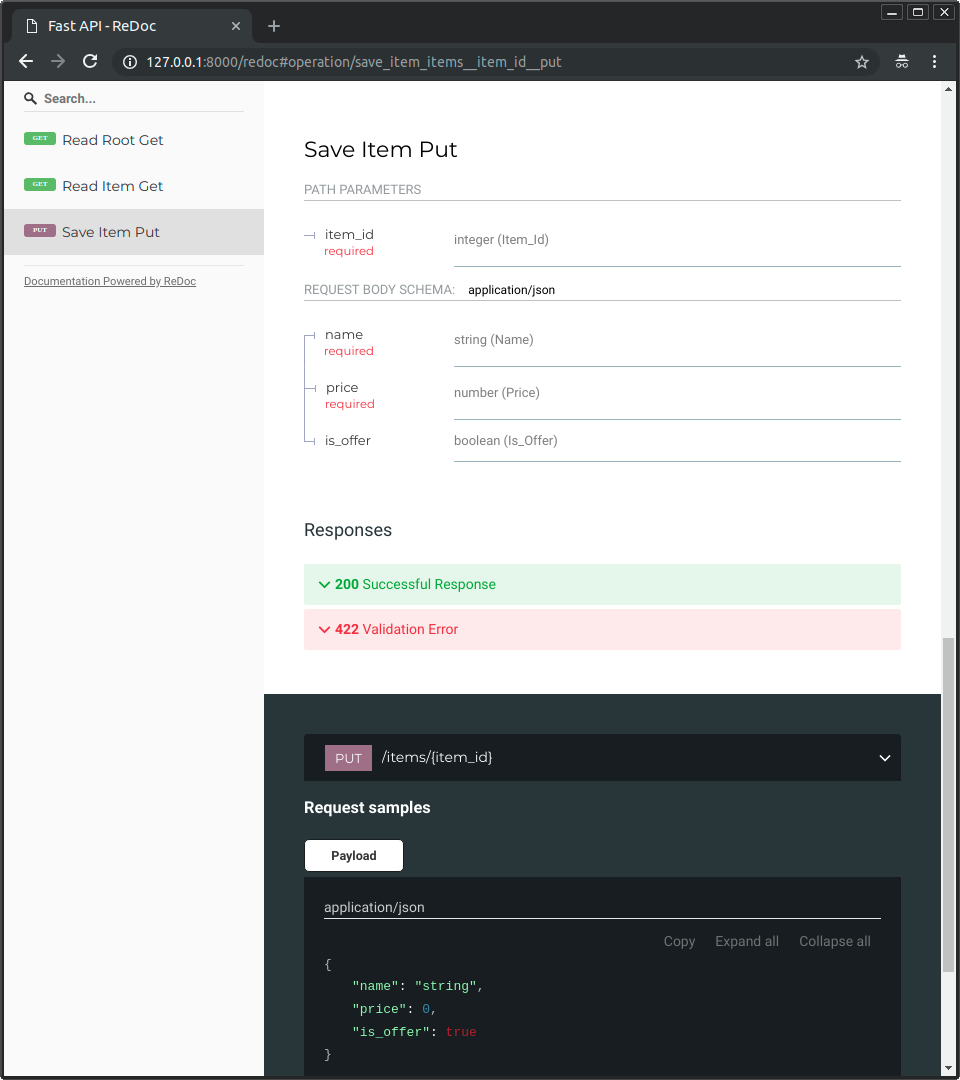 ### Resumen { #recap } En resumen, declaras **una vez** los tipos de parámetros, body, etc. como parámetros de función. Lo haces con tipos estándar modernos de Python. No tienes que aprender una nueva sintaxis, los métodos o clases de un paquete específico, etc. Solo **Python** estándar. Por ejemplo, para un `int`: ```PythonCreated: Sun Apr 05 07:19:11 GMT 2026 - Last Modified: Thu Mar 19 18:15:55 GMT 2026 - 22.6K bytes - Click Count (0) -
docs/es/docs/tutorial/handling-errors.md
{* ../../docs_src/handling_errors/tutorial006_py310.py hl[2:5,15,21] *}Created: Sun Apr 05 07:19:11 GMT 2026 - Last Modified: Thu Mar 19 18:15:55 GMT 2026 - 9.6K bytes - Click Count (0) -
docs/es/docs/tutorial/security/first-steps.md
/// check | ¡Botón de autorización!

Ya tienes un nuevo y brillante botón de "Authorize".

Y tu *path operation* tiene un pequeño candado en la esquina superior derecha que puedes pulsar.

///

Y si lo haces, tendrás un pequeño formulario de autorización para escribir un `username` y `password` (y otros campos opcionales):

<img src="/img/tutorial/security/image02.png">

/// note | Nota
Created: Sun Apr 05 07:19:11 GMT 2026 - Last Modified: Thu Mar 19 18:15:55 GMT 2026 - 8.8K bytes - Click Count (0) -
docs/es/docs/advanced/generate-clients.md
Esto también significa que si algo cambió será **reflejado** automáticamente en el código del cliente. Y si haces **build** del cliente, dará error si tienes algún **desajuste** en los datos utilizados.
Created: Sun Apr 05 07:19:11 GMT 2026 - Last Modified: Thu Mar 19 18:15:55 GMT 2026 - 10.4K bytes - Click Count (0) -
docs/es/docs/advanced/custom-response.md
{* ../../docs_src/custom_response/tutorial006_py310.py hl[2,9] *}

---

O puedes usarlo en el parámetro `response_class`:


{* ../../docs_src/custom_response/tutorial006b_py310.py hl[2,7,9] *}

Si haces eso, entonces puedes devolver la URL directamente desde tu *path operation* function.

En este caso, el `status_code` utilizado será el por defecto para `RedirectResponse`, que es `307`.

---
Created: Sun Apr 05 07:19:11 GMT 2026 - Last Modified: Thu Mar 19 18:15:55 GMT 2026 - 11.6K bytes - Click Count (0) -
docs/es/docs/help-fastapi.md
* Hacer una **pregunta** o preguntar sobre un **problema**.
* Sugerir una nueva **funcionalidad**.

**Nota**: si lo haces, entonces te voy a pedir que también ayudes a otros. 😉

## Revisa Pull Requests { #review-pull-requests }

Puedes ayudarme a revisar pull requests de otros.
Created: Sun Apr 05 07:19:11 GMT 2026 - Last Modified: Thu Mar 19 18:15:55 GMT 2026 - 13.4K bytes - Click Count (0) -
docs/es/docs/deployment/concepts.md
Cuando configuras un servidor remoto (un servidor en la nube, una máquina virtual, etc.) lo más sencillo que puedes hacer es usar `fastapi run` (que utiliza Uvicorn) o algo similar, manualmente, de la misma manera que lo haces al desarrollar localmente.

Y funcionará y será útil **durante el desarrollo**.

Pero si pierdes la conexión con el servidor, el **proceso en ejecución** probablemente morirá.
Created: Sun Apr 05 07:19:11 GMT 2026 - Last Modified: Thu Mar 19 18:15:55 GMT 2026 - 20K bytes - Click Count (0) -
android/guava-tests/test/com/google/common/io/testdata/alice_in_wonderland.txt
she comes, to--'  At this moment Five, who had been anxiously
looking across the garden, called out `The Queen!  The Queen!'
and the three gardeners instantly threw themselves flat upon
their faces.  There was a sound of many footsteps, and Alice
looked round, eager to see the Queen.

  First came ten soldiers carrying clubs; these were all shaped
like the three gardeners, oblong and flat, with their hands and
Created: Fri Apr 03 12:43:13 GMT 2026 - Last Modified: Fri Apr 21 02:27:51 GMT 2017 - 145.2K bytes - Click Count (0) -
guava-tests/test/com/google/common/io/testdata/alice_in_wonderland.txt
she comes, to--'  At this moment Five, who had been anxiously
looking across the garden, called out `The Queen!  The Queen!'
and the three gardeners instantly threw themselves flat upon
their faces.  There was a sound of many footsteps, and Alice
looked round, eager to see the Queen.

  First came ten soldiers carrying clubs; these were all shaped
like the three gardeners, oblong and flat, with their hands and
Created: Fri Apr 03 12:43:13 GMT 2026 - Last Modified: Mon Oct 29 21:35:03 GMT 2012 - 145.2K bytes - Click Count (0)