- Sort Score
- Num 10 results
- Language All
Results 621 - 630 of 1,366 for proxied (0.05 seconds)
-
docs/en/docs/advanced/settings.md
Most of these settings are variable (can change), like database URLs. And many could be sensitive, like secrets.

For this reason it's common to provide them in environment variables that are read by the application.

/// tip

To understand environment variables you can read [Environment Variables](../environment-variables.md){.internal-link target=_blank}.

///
Created: Sun Dec 28 07:19:09 GMT 2025 - Last Modified: Sat Dec 20 15:55:38 GMT 2025 - 11.2K bytes - Click Count (0) -
android/guava/src/com/google/common/graph/Graph.java
   *
   * <p>A reference implementation of this is provided by {@link AbstractGraph#equals(Object)}.
   */
  @Override
  boolean equals(@Nullable Object object);

  /**
   * Returns the hash code for this graph. The hash code of a graph is defined as the hash code of
   * the set returned by {@link #edges()}.
   *
   * <p>A reference implementation of this is provided by {@link AbstractGraph#hashCode()}.
   */
  @Override
Created: Fri Dec 26 12:43:10 GMT 2025 - Last Modified: Mon Mar 17 20:26:29 GMT 2025 - 13.6K bytes - Click Count (0) -
guava/src/com/google/common/graph/Graph.java
   *
   * <p>A reference implementation of this is provided by {@link AbstractGraph#equals(Object)}.
   */
  @Override
  boolean equals(@Nullable Object object);

  /**
   * Returns the hash code for this graph. The hash code of a graph is defined as the hash code of
   * the set returned by {@link #edges()}.
   *
   * <p>A reference implementation of this is provided by {@link AbstractGraph#hashCode()}.
   */
  @Override
Created: Fri Dec 26 12:43:10 GMT 2025 - Last Modified: Mon Mar 17 20:26:29 GMT 2025 - 13.6K bytes - Click Count (0) -
okhttp/src/commonJvmAndroid/kotlin/okhttp3/internal/http2/Http2Connection.kt
  /** Settings we communicate to the peer. */
  val okHttpSettings =
    Settings().apply {
      // Flow control was designed more for servers, or proxies than edge clients. If we are a client,
      // set the flow control window to 16MiB.  This avoids thrashing window updates every 64KiB, yet
      // small enough to avoid blowing up the heap.
      if (builder.client) {
Created: Fri Dec 26 11:42:13 GMT 2025 - Last Modified: Thu Jul 31 04:18:40 GMT 2025 - 31.8K bytes - Click Count (0) -
src/main/java/org/codelibs/fess/app/web/admin/scheduler/AdminSchedulerAction.java
        });
        return asHtml(path_AdminScheduler_AdminSchedulerJsp).renderWith(data -> {
            searchPaging(data, form);
        });
    }

    /**
     * Searches for scheduled jobs based on the provided search criteria.
     *
     * @param form the search form containing search criteria
     * @return HTML response with filtered scheduled job results
     */
    @Execute
    @Secured({ ROLE, ROLE + VIEW })
Created: Sat Dec 20 09:19:18 GMT 2025 - Last Modified: Thu Nov 20 13:56:35 GMT 2025 - 21.8K bytes - Click Count (0) -
docs/en/docs/tutorial/first-steps.md
### Interactive API docs { #interactive-api-docs } Now go to <a href="http://127.0.0.1:8000/docs" class="external-link" target="_blank">http://127.0.0.1:8000/docs</a>. You will see the automatic interactive API documentation (provided by <a href="https://github.com/swagger-api/swagger-ui" class="external-link" target="_blank">Swagger UI</a>): 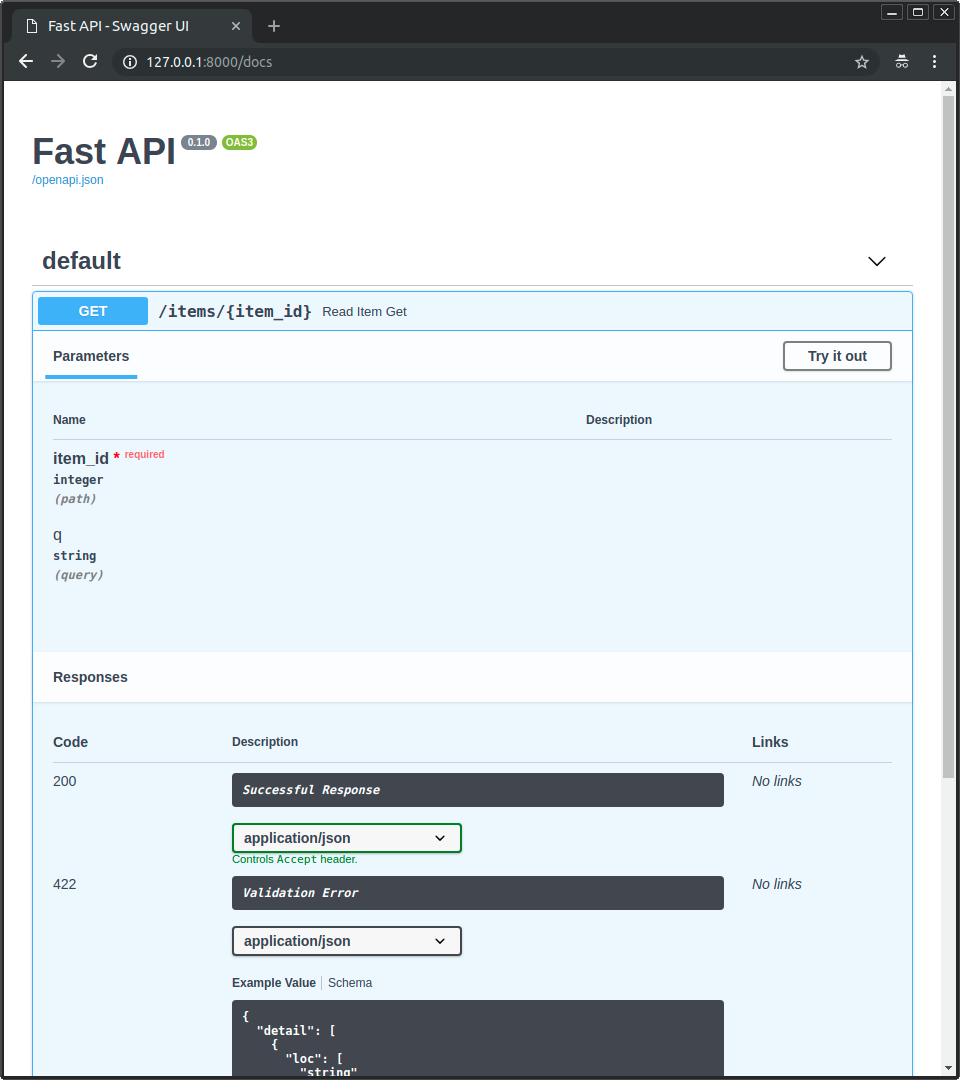Created: Sun Dec 28 07:19:09 GMT 2025 - Last Modified: Wed Dec 17 20:41:43 GMT 2025 - 12.8K bytes - Click Count (0) -
compat/maven-repository-metadata/src/site/apt/index.apt
       <<<versioning>>> element that gives data about snapshot (<<<snapshot>>>, <<<lastUpdated>>> and <<<snapshotVersions>>> list). Notice that a
       release artifact directory is not expected to provide metadata.

 []

 The following are generated from this model:

   * {{{./apidocs/index.html}Java sources}} with Reader and Writers for the Xpp3 XML parser, to read and write <<<maven-metadata(-*).xml>>> files,
Created: Sun Dec 28 03:35:09 GMT 2025 - Last Modified: Sun Nov 16 18:16:44 GMT 2025 - 2.5K bytes - Click Count (0) -
docs/es/docs/tutorial/body.md
Como no se recomienda, la documentación interactiva con Swagger UI no mostrará la documentación para el body cuando se usa `GET`, y los proxies intermedios podrían no soportarlo.

///

## Importar `BaseModel` de Pydantic { #import-pydantics-basemodel }

Primero, necesitas importar `BaseModel` de `pydantic`:
Created: Sun Dec 28 07:19:09 GMT 2025 - Last Modified: Wed Dec 17 20:41:43 GMT 2025 - 7.6K bytes - Click Count (0) -
okhttp/src/commonJvmAndroid/kotlin/okhttp3/Address.kt
  protocols: List<Protocol>,
  connectionSpecs: List<ConnectionSpec>,
  /**
   * Returns this address's proxy selector. Only used if the proxy is null. If none of this
   * selector's proxies are reachable, a direct connection will be attempted.
   */
  @get:JvmName("proxySelector") val proxySelector: ProxySelector,
) {
  /**
Created: Fri Dec 26 11:42:13 GMT 2025 - Last Modified: Wed Mar 19 19:25:20 GMT 2025 - 7.3K bytes - Click Count (0) -
fess-crawler/src/main/java/org/codelibs/fess/crawler/client/http/conn/IdnDnsResolver.java
import java.net.URLDecoder;
import java.net.UnknownHostException;

import org.apache.http.conn.DnsResolver;

/**
 * The {@code IdnDnsResolver} class implements the {@code DnsResolver} interface
 * to provide DNS resolution with support for Internationalized Domain Names (IDN).
 * It converts Unicode domain names to ASCII Compatible Encoding (ACE) using the
 * {@link java.net.IDN} class.
 *
Created: Sat Dec 20 11:21:39 GMT 2025 - Last Modified: Thu Nov 06 07:24:43 GMT 2025 - 3.9K bytes - Click Count (0)