- Sort Score
- Result 10 results
- Languages All
Results 451 - 460 of 560 for tutorials (2.55 sec)
-
docs/pt/docs/how-to/migrate-from-pydantic-v1-to-pydantic-v2.md
Ele também inclui o que mudou, como as validações agora são mais corretas e rigorosas, possíveis ressalvas, etc.

Você pode lê-lo para entender melhor o que mudou.

## Testes { #tests }

Garanta que você tenha [testes](../tutorial/testing.md){.internal-link target=_blank} para sua aplicação e que os execute na integração contínua (CI).

Assim, você pode fazer a atualização e garantir que tudo continua funcionando como esperado.
Registered: Sun Dec 28 07:19:09 UTC 2025 - Last Modified: Wed Nov 12 16:23:57 UTC 2025 - 5.8K bytes - Viewed (0) -
docs/en/docs/tutorial/dependencies/classes-as-dependencies.md
But declaring the type is encouraged as that way your editor will know what will be passed as the parameter `commons`, and then it can help you with code completion, type checks, etc:

<img src="/img/tutorial/dependencies/image02.png">

## Shortcut { #shortcut }

But you see that we are having some code repetition here, writing `CommonQueryParams` twice:

//// tab | Python 3.9+

```Python
Registered: Sun Dec 28 07:19:09 UTC 2025 - Last Modified: Wed Dec 17 20:41:43 UTC 2025 - 6.7K bytes - Viewed (0) -
docs/pt/docs/tutorial/dependencies/classes-as-dependencies.md
Mas declarar o tipo é encorajado por que é a forma que o seu editor de texto sabe o que será passado como valor do parâmetro `commons`, e assim ele pode ajudar com preenchimento automático, verificações de tipo, etc:

<img src="/img/tutorial/dependencies/image02.png">

## Pegando um Atalho { #shortcut }

Mas você pode ver que temos uma repetição do código neste exemplo, escrevendo `CommonQueryParams` duas vezes:

//// tab | Python 3.9+
Registered: Sun Dec 28 07:19:09 UTC 2025 - Last Modified: Wed Dec 17 20:41:43 UTC 2025 - 7.3K bytes - Viewed (0) -
docs/es/docs/tutorial/query-params-str-validations.md
///

La documentación interactiva de API se actualizará en consecuencia, para permitir múltiples valores:

<img src="/img/tutorial/query-params-str-validations/image02.png">

### Lista de parámetros de Query / múltiples valores con valores por defecto { #query-parameter-list-multiple-values-with-defaults }
Registered: Sun Dec 28 07:19:09 UTC 2025 - Last Modified: Wed Dec 17 20:41:43 UTC 2025 - 18.4K bytes - Viewed (0) -
README.md
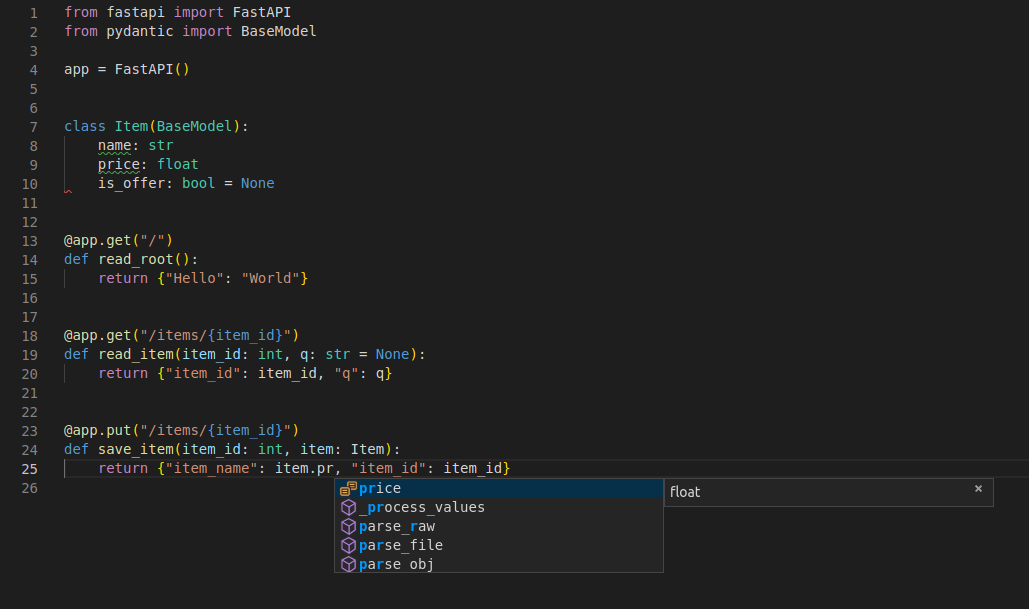 For a more complete example including more features, see the <a href="https://fastapi.tiangolo.com/tutorial/">Tutorial - User Guide</a>. **Spoiler alert**: the tutorial - user guide includes: * Declaration of **parameters** from other different places as: **headers**, **cookies**, **form fields** and **files**.
Registered: Sun Dec 28 07:19:09 UTC 2025 - Last Modified: Thu Dec 25 11:01:37 UTC 2025 - 26.4K bytes - Viewed (0) -
docs/uk/docs/tutorial/body-nested-models.md
наприклад:

{* ../../docs_src/body_nested_models/tutorial008_py39.py hl[13] *}

## Підтримка в редакторі всюди

Ви отримаєте підтримку в редакторі всюди.

Навіть для елементів у списках:

<img src="/img/tutorial/body-nested-models/image01.png">

Ви не змогли б отримати таку підтримку в редакторі, якби працювали напряму зі  `dict`, а не з моделями Pydantic.
Registered: Sun Dec 28 07:19:09 UTC 2025 - Last Modified: Fri Feb 28 14:18:01 UTC 2025 - 10.8K bytes - Viewed (0) -
tests/test_tutorial/test_sql_databases/test_tutorial002.py
        pytest.param("tutorial002_an_py310", marks=needs_py310),
    ],
)
def get_client(request: pytest.FixtureRequest):
    clear_sqlmodel()
    # TODO: remove when updating SQL tutorial to use new lifespan API
    with warnings.catch_warnings(record=True):
        warnings.simplefilter("always")
        mod = importlib.import_module(f"docs_src.sql_databases.{request.param}")
        clear_sqlmodel()
Registered: Sun Dec 28 07:19:09 UTC 2025 - Last Modified: Sat Dec 27 18:19:10 UTC 2025 - 17.9K bytes - Viewed (0) -
docs/de/docs/tutorial/query-params-str-validations.md
///

Die interaktive API-Dokumentation wird entsprechend aktualisiert, um mehrere Werte zu erlauben:

<img src="/img/tutorial/query-params-str-validations/image02.png">

### Query-Parameter-Liste / Mehrere Werte mit Defaults { #query-parameter-list-multiple-values-with-defaults }
Registered: Sun Dec 28 07:19:09 UTC 2025 - Last Modified: Wed Dec 24 10:28:19 UTC 2025 - 19.1K bytes - Viewed (0) -
docs/pt/docs/tutorial/query-params-str-validations.md
///

A documentação interativa da API será atualizada de acordo, permitindo múltiplos valores:

<img src="/img/tutorial/query-params-str-validations/image02.png">

### Lista de parâmetros de consulta / múltiplos valores com valores padrão { #query-parameter-list-multiple-values-with-defaults }
Registered: Sun Dec 28 07:19:09 UTC 2025 - Last Modified: Wed Dec 17 20:41:43 UTC 2025 - 18.2K bytes - Viewed (0) -
docs/en/docs/advanced/path-operation-advanced-configuration.md
{* ../../docs_src/path_operation_advanced_configuration/tutorial005_py39.py hl[6] *}

If you open the automatic API docs, your extension will show up at the bottom of the specific *path operation*.

<img src="/img/tutorial/path-operation-advanced-configuration/image01.png">

And if you see the resulting OpenAPI (at `/openapi.json` in your API), you will see your extension as part of the specific *path operation* too:

```JSON hl_lines="22"
Registered: Sun Dec 28 07:19:09 UTC 2025 - Last Modified: Sat Dec 20 15:55:38 UTC 2025 - 7.2K bytes - Viewed (0)