- Sort Score
- Num 10 results
- Language All
Results 581 - 590 of 4,617 for httpx (0.02 seconds)
-
docs/es/docs/tutorial/request-files.md
Created: Sun Dec 28 07:19:09 GMT 2025 - Last Modified: Tue Dec 16 16:33:45 GMT 2025 - 7.9K bytes - Click Count (0) -
docs/zh/docs/tutorial/request-files.md
编码和表单字段详见 <a href="https://developer.mozilla.org/zh-CN/docs/Web/HTTP/Methods/POST" class="external-link" target="_blank"><abbr title="Mozilla Developer Network">MDN</abbr> Web 文档的 <code>POST </code></a> 小节。

///

/// warning | 警告

可在一个*路径操作*中声明多个 `File` 和 `Form` 参数,但不能同时声明要接收 JSON 的 `Body` 字段。因为此时请求体的编码是 `multipart/form-data`,不是 `application/json`。

这不是 **FastAPI** 的问题,而是 HTTP 协议的规定。

///

## 可选文件上传
Created: Sun Dec 28 07:19:09 GMT 2025 - Last Modified: Mon Nov 18 02:25:44 GMT 2024 - 6.3K bytes - Click Count (0) -
docs/ko/docs/deployment/docker.md
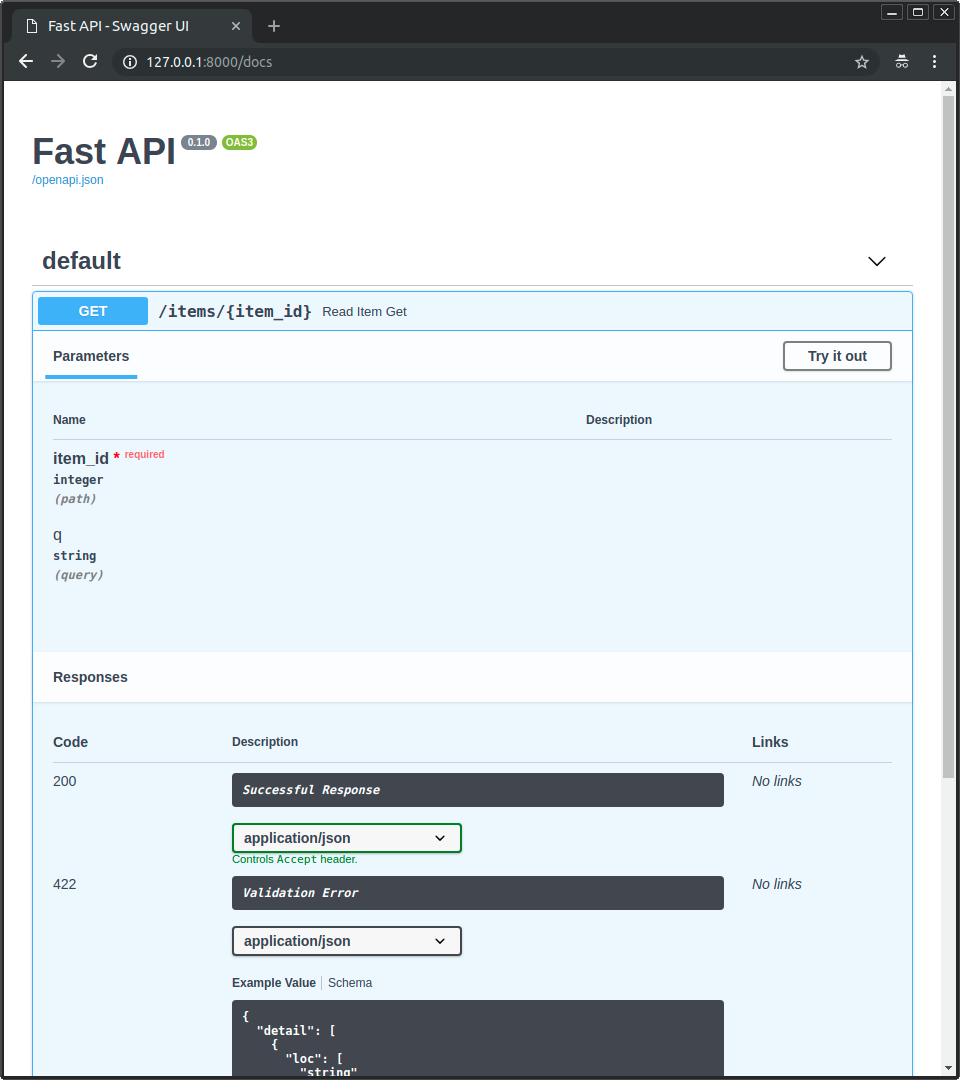 ## 대안 API 문서 또한 여러분은 <a href="http://192.168.99.100/redoc" class="external-link" target="_blank">http://192.168.99.100/redoc</a> 또는 <a href="http://127.0.0.1/redoc" class="external-link" target="_blank">http://127.0.0.1/redoc</a>으로 이동할 수 있습니다(또는, 여러분의 도커 호스트를 이용할 수 있습니다).
Created: Sun Dec 28 07:19:09 GMT 2025 - Last Modified: Sat Nov 09 16:39:20 GMT 2024 - 42.7K bytes - Click Count (0) -
docs/en/docs/tutorial/request-forms-and-files.md
# Request Forms and Files { #request-forms-and-files }

You can define files and form fields at the same time using `File` and `Form`.

/// info

To receive uploaded files and/or form data, first install <a href="https://github.com/Kludex/python-multipart" class="external-link" target="_blank">`python-multipart`</a>.

Make sure you create a [virtual environment](../virtual-environments.md){.internal-link target=_blank}, activate it, and then install it, for example:
Created: Sun Dec 28 07:19:09 GMT 2025 - Last Modified: Sun Aug 31 09:15:41 GMT 2025 - 1.5K bytes - Click Count (0) -
build-logic/integration-testing/src/main/kotlin/gradlebuild/integrationtests/tasks/GenerateLanguageAnnotations.kt
import org.gradle.api.tasks.CompileClasspath
import org.gradle.api.tasks.Input
import org.gradle.api.tasks.OutputDirectory
import org.gradle.api.tasks.TaskAction
// Using star import to workaround https://youtrack.jetbrains.com/issue/KTIJ-24390
import org.gradle.kotlin.dsl.*
import org.gradle.workers.WorkerExecutor
import javax.inject.Inject


@CacheableTask
abstract class GenerateLanguageAnnotations : DefaultTask() {
Created: Wed Dec 31 11:36:14 GMT 2025 - Last Modified: Fri Apr 07 08:27:12 GMT 2023 - 2K bytes - Click Count (0) -
cmd/server-rlimit.go
		debug.SetMemoryLimit(int64(ctx.MemLimit))
	}

	// Do not use RLIMIT_AS as that is not useful and at times on systems < 4Gi
	// this can crash the Go runtime if the value is smaller refer
	// - https://github.com/golang/go/issues/38010
	// - https://github.com/golang/go/issues/43699
	// So do not add `sys.SetMaxMemoryLimit()` this is not useful for any practical purposes.
	return nil
Created: Sun Dec 28 19:28:13 GMT 2025 - Last Modified: Tue Jul 02 15:09:36 GMT 2024 - 2.8K bytes - Click Count (0) -
docs/uk/docs/tutorial/background-tasks.md
А потім інша фонова задача, яка створюється у *функції операції шляху*, запише повідомлення з використанням path параметра `email`.

## Технічні деталі

Клас `BackgroundTasks` походить безпосередньо з <a href="https://www.starlette.dev/background/" class="external-link" target="_blank">`starlette.background`</a>.
Created: Sun Dec 28 07:19:09 GMT 2025 - Last Modified: Sat Oct 11 17:48:49 GMT 2025 - 7.6K bytes - Click Count (0) -
helm-releases/minio-3.3.2.tgz
.hg/ .hgignore .svn/ # Common backup files *.swp *.bak *.tmp *~ # Various IDEs .project .idea/ *.tmproj # OWNERS file for Kubernetes OWNERS minio/README.md # MinIO Helm Chart [](https://slack.min.io) [](https://github.com/minio/minio/blob/master/LICENSE) MinIO is a High Performance Object Storage released under GNU Affero General Public License v3.0. It is API compatible with Amazon S3 cloud...
Created: Sun Dec 28 19:28:13 GMT 2025 - Last Modified: Sat Dec 11 17:26:01 GMT 2021 - 14.6K bytes - Click Count (0) -
helm-releases/minio-3.3.4.tgz
.hg/ .hgignore .svn/ # Common backup files *.swp *.bak *.tmp *~ # Various IDEs .project .idea/ *.tmproj # OWNERS file for Kubernetes OWNERS minio/README.md # MinIO Helm Chart [](https://slack.min.io) [](https://github.com/minio/minio/blob/master/LICENSE) MinIO is a High Performance Object Storage released under GNU Affero General Public License v3.0. It is API compatible with Amazon S3 cloud...
Created: Sun Dec 28 19:28:13 GMT 2025 - Last Modified: Sat Dec 11 17:59:34 GMT 2021 - 14.6K bytes - Click Count (0) -
docs/zh/docs/deployment/manually.md
除此之外,还有其他一些可选的 ASGI 服务器,例如:

* <a href="https://www.uvicorn.dev/" class="external-link" target="_blank">Uvicorn</a>:高性能 ASGI 服务器。
* <a href="https://hypercorn.readthedocs.io/" class="external-link" target="_blank">Hypercorn</a>:与 HTTP/2 和 Trio 等兼容的 ASGI 服务器。
* <a href="https://github.com/django/daphne" class="external-link" target="_blank">Daphne</a>:为 Django Channels 构建的 ASGI 服务器。
Created: Sun Dec 28 07:19:09 GMT 2025 - Last Modified: Sat Oct 11 17:48:49 GMT 2025 - 6.7K bytes - Click Count (0)