- Sort Score
- Num 10 results
- Language All
Results 461 - 470 of 545 for Nonce (0.03 seconds)
-
okhttp/src/commonJvmAndroid/kotlin/okhttp3/internal/cache/DiskLruCache.kt
     * an I/O error, or if the target entry is evicted while this editor is active. In either case
     * we delete the editor's created files and prevent new files from being created. Note that once
     * an editor has been detached it is possible for another editor to edit the entry.
     */
    internal fun detach() {
      if (entry.currentEditor == this) {
        if (civilizedFileSystem) {
Created: Fri Dec 26 11:42:13 GMT 2025 - Last Modified: Wed May 28 23:28:25 GMT 2025 - 34.7K bytes - Click Count (0) -
cmd/common-main.go
	gob.Register(madmin.TimeInfo{})
	gob.Register(madmin.XFSErrorConfigs{})
	gob.Register(map[string]string{})
	gob.Register(map[string]any{})

	// All minio-go and madmin-go API operations shall be performed only once,
	// another way to look at this is we are turning off retries.
	minio.MaxRetry = 1
	madmin.MaxRetry = 1

	currentReleaseTime, _ = GetCurrentReleaseTime()
}

const consolePrefix = "CONSOLE_"
Created: Sun Dec 28 19:28:13 GMT 2025 - Last Modified: Fri Aug 29 02:39:48 GMT 2025 - 32.5K bytes - Click Count (3) -
android/guava-tests/test/com/google/common/base/PredicatesTest.java
  }

  /**
   * Tests for Predicates.contains(Pattern) and .containsPattern(String). We assume the regex level
   * works, so there are only trivial tests of that aspect. TODO: Fix comment style once annotation
   * stripper is fixed.
   */
  @GwtIncompatible // Predicates.containsPattern
  public void testContainsPattern_apply() {
    Predicate<CharSequence> isFoobar = Predicates.containsPattern("^Fo.*o.*bar$");
Created: Fri Dec 26 12:43:10 GMT 2025 - Last Modified: Tue Oct 28 16:03:47 GMT 2025 - 32.3K bytes - Click Count (0) -
guava/src/com/google/common/collect/ImmutableBiMap.java
    public ImmutableBiMap<K, V> build() {
      return buildOrThrow();
    }

    /**
     * Returns a newly-created immutable bimap, or throws an exception if any key or value was added
     * more than once. The iteration order of the returned bimap is the order in which entries were
     * inserted into the builder, unless {@link #orderEntriesByValue} was called, in which case
     * entries are sorted by value.
     *
Created: Fri Dec 26 12:43:10 GMT 2025 - Last Modified: Tue Sep 23 17:50:58 GMT 2025 - 22.7K bytes - Click Count (0) -
android/guava/src/com/google/common/collect/Multisets.java
   * Elements are added in encounter order.
   *
   * <p>If the mapped elements contain duplicates (according to {@link Object#equals}), the element
   * will be added more than once, with the count summed over all appearances of the element.
   *
   * <p>Note that {@code stream.collect(toMultiset(function, e -> 1, supplier))} is equivalent to
Created: Fri Dec 26 12:43:10 GMT 2025 - Last Modified: Mon Sep 22 18:35:44 GMT 2025 - 41.3K bytes - Click Count (0) -
android/guava/src/com/google/common/collect/Streams.java
                return false;
              }
            },
            isParallel)
        .onClose(streamA::close)
        .onClose(streamB::close);
  }

  /**
   * Invokes {@code consumer} once for each pair of <i>corresponding</i> elements in {@code streamA}
   * and {@code streamB}. If one stream is longer than the other, the extra elements are silently
Created: Fri Dec 26 12:43:10 GMT 2025 - Last Modified: Tue Oct 21 15:40:45 GMT 2025 - 36.8K bytes - Click Count (0) -
android/guava/src/com/google/common/primitives/Ints.java
    // The Dolphin algorithm is attractive because it does the fewest array reads and writes: each
    // array slot is read and written exactly once. However, it can have very poor memory locality:
    // benchmarking shows it can take 7 times longer than the other two in some cases. The other two
Created: Fri Dec 26 12:43:10 GMT 2025 - Last Modified: Wed Oct 22 18:14:49 GMT 2025 - 31.3K bytes - Click Count (0) -
guava/src/com/google/common/collect/Multisets.java
   * Elements are added in encounter order.
   *
   * <p>If the mapped elements contain duplicates (according to {@link Object#equals}), the element
   * will be added more than once, with the count summed over all appearances of the element.
   *
   * <p>Note that {@code stream.collect(toMultiset(function, e -> 1, supplier))} is equivalent to
Created: Fri Dec 26 12:43:10 GMT 2025 - Last Modified: Mon Sep 22 18:35:44 GMT 2025 - 41.2K bytes - Click Count (0) -
guava/src/com/google/common/collect/CompactHashMap.java
   * errors, for better performance.
   *
   * <p>For a new instance, where the arrays above have not yet been allocated, the value of {@code
   * metadata} is the size that the arrays should be allocated with. Once the arrays have been
   * allocated, the value of {@code metadata} combines the number of bits in the "short hash", in
   * its bottom {@value CompactHashing#HASH_TABLE_BITS_MAX_BITS} bits, with a modification count in
Created: Fri Dec 26 12:43:10 GMT 2025 - Last Modified: Tue Jul 08 18:32:10 GMT 2025 - 39.6K bytes - Click Count (0) -
README.md
* The alternative documentation will also reflect the new query parameter and body: 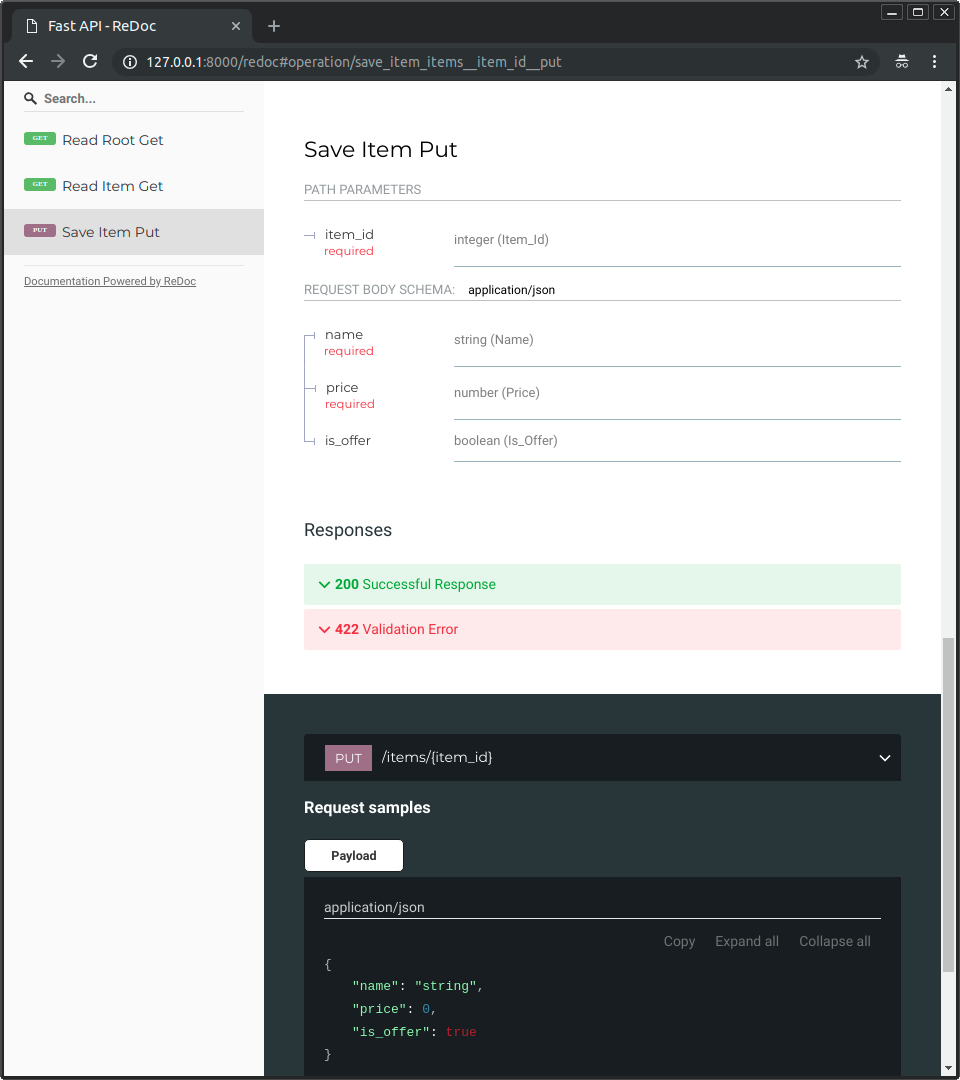 ### Recap In summary, you declare **once** the types of parameters, body, etc. as function parameters. You do that with standard modern Python types. You don't have to learn a new syntax, the methods or classes of a specific library, etc.
Created: Sun Dec 28 07:19:09 GMT 2025 - Last Modified: Thu Dec 25 11:01:37 GMT 2025 - 26.4K bytes - Click Count (0)