- Sort Score
- Num 10 results
- Language All
Results 231 - 240 of 524 for owns (0.02 seconds)
-
guava-tests/test/com/google/common/base/PreconditionsTest.java
    // ambiguous without the cast to Object because the boxed predicate prevents any overload from
    // being selected in phase 1
    checkState(boxedBoolean, "", (Object) boxedLong);

    // ternaries introduce their own problems. because of the ternary (which requires a boxing
    // operation) no overload can be selected in phase 1.  and in phase 2 it is ambiguous since it
Created: Fri Apr 03 12:43:13 GMT 2026 - Last Modified: Fri Mar 13 13:01:07 GMT 2026 - 19.1K bytes - Click Count (0) -
compat/maven-artifact/src/main/java/org/apache/maven/artifact/resolver/AbstractArtifactResolutionException.java
Created: Sun Apr 05 03:35:12 GMT 2026 - Last Modified: Tue Apr 01 21:22:14 GMT 2025 - 10.1K bytes - Click Count (0) -
docs/en/docs/how-to/migrate-from-pydantic-v1-to-pydantic-v2.md
///

### Pydantic v1 and v2 on the same app { #pydantic-v1-and-v2-on-the-same-app }

It's **not supported** by Pydantic to have a model of Pydantic v2 with its own fields defined as Pydantic v1 models or vice versa.

```mermaid
graph TB
    subgraph "❌ Not Supported"
        direction TB
        subgraph V2["Pydantic v2 Model"]
            V1Field["Pydantic v1 Model"]
Created: Sun Apr 05 07:19:11 GMT 2026 - Last Modified: Thu Mar 05 18:13:19 GMT 2026 - 5.4K bytes - Click Count (0) -
CONTRIBUTING.md
- Changes are consistent with the [Coding Style](#c-coding-style). - Run the [unit tests](#running-unit-tests). ## How to become a contributor and submit your own code 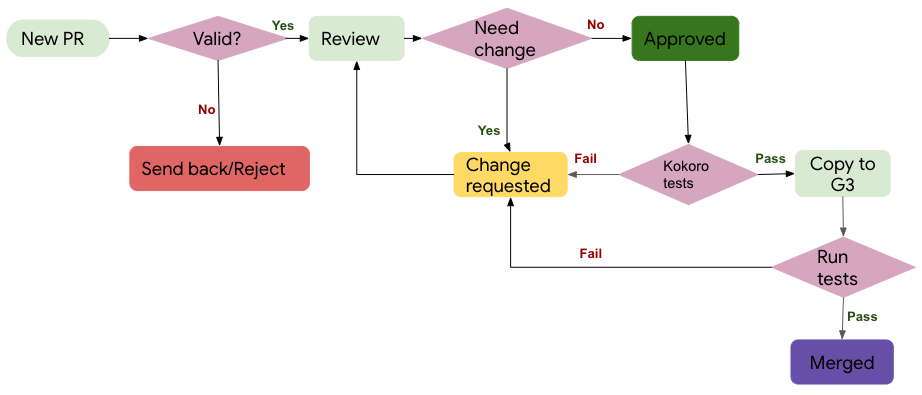 ### Typical Pull Request Workflow - **1. New PR**
Created: Tue Apr 07 12:39:13 GMT 2026 - Last Modified: Sat Jan 11 04:47:59 GMT 2025 - 15.9K bytes - Click Count (0) -
okhttp-tls/src/main/kotlin/okhttp3/tls/HandshakeCertificates.kt
 *
 * ### Server Authentication
 *
 * This is the most common form of TLS authentication: clients verify that servers are trusted and
 * that they own the hostnames that they represent. Server authentication is required.
 *
 * To perform server authentication:
 *
 *  * The server's handshake certificates must have a [held certificate][HeldCertificate] (a
Created: Fri Apr 03 11:42:14 GMT 2026 - Last Modified: Sat May 10 11:15:14 GMT 2025 - 8.4K bytes - Click Count (0) -
gradle/wrapper/gradle-wrapper.jar
normally appear. The contents of the NOTICE file are for informational purposes only and do not modify the License. You may add Your own attribution notices within Derivative Works that You distribute, alongside or as an addendum to the NOTICE text from the Work, provided that such additional attribution notices cannot be construed as modifying the License. You may add Your own copyright statement to Your modifications and may provide additional or different license terms and conditions for use, reproduction,...
Created: Fri Apr 03 11:42:14 GMT 2026 - Last Modified: Wed Mar 04 20:34:40 GMT 2026 - 47.8K bytes - Click Count (1) -
src/test/java/org/codelibs/fess/exception/UserRoleLoginExceptionTest.java
            assertEquals(0, e.getStackTrace().length);
        }
    }

    @Test
    public void test_multipleInstances() {
        // Test that multiple instances maintain their own state
        UserRoleLoginException exception1 = new UserRoleLoginException(RootAction.class);
        UserRoleLoginException exception2 = new UserRoleLoginException(RootAction.class);
Created: Tue Mar 31 13:07:34 GMT 2026 - Last Modified: Fri Mar 13 23:01:26 GMT 2026 - 11K bytes - Click Count (0) -
android/guava-testlib/test/com/google/common/collect/testing/features/FeatureUtilTest.java
    @interface NotTesterAnnotation {
      ExampleFeature[] value() default {};

      ExampleFeature[] absent() default {};
    }
  }

  public void testTestFeatureEnums() {
    // Haha! Let's test our own test rig!
    assertGoodFeatureEnum(ExampleFeature.class);
  }

  public void testAddImpliedFeatures_returnsSameSetInstance() {
    Set<Feature<?>> features = newHashSet(FOO);
Created: Fri Apr 03 12:43:13 GMT 2026 - Last Modified: Mon Jul 14 14:44:08 GMT 2025 - 11.6K bytes - Click Count (0) -
android/guava/src/com/google/common/escape/CharEscaper.java
* multiple threads. * * <p>Popular escapers are defined as constants in classes like {@link * com.google.common.html.HtmlEscapers} and {@link com.google.common.xml.XmlEscapers}. To create * your own escapers extend this class and implement the {@link #escape(char)} method. * * @author Sven Mawson * @since 15.0 */ @GwtCompatible @SuppressWarnings("EscapedEntity") // We do mean for the user to see "<" etc.Created: Fri Apr 03 12:43:13 GMT 2026 - Last Modified: Thu Feb 13 15:45:16 GMT 2025 - 6.7K bytes - Click Count (0) -
guava/src/com/google/common/collect/ForwardingSortedMultiset.java
 * #add(Object, int)} alone <b>will not</b> change the behavior of {@link #add(Object)}, which can
 * lead to unexpected behavior. In this case, you should override {@code add(Object)} as well,
 * either providing your own implementation, or delegating to the provided {@code standardAdd}
 * method.
 *
 * <p><b>{@code default} method warning:</b> This class does <i>not</i> forward calls to {@code
Created: Fri Apr 03 12:43:13 GMT 2026 - Last Modified: Thu Aug 07 16:05:33 GMT 2025 - 8.6K bytes - Click Count (0)