- Sort Score
- Num 10 results
- Language All
Results 181 - 190 of 1,992 for Fastapi (0.05 seconds)
-
tests/test_additional_properties_bool.py
from typing import Union

from fastapi import FastAPI
from fastapi.testclient import TestClient
from pydantic import BaseModel, ConfigDict


class FooBaseModel(BaseModel):
    model_config = ConfigDict(extra="forbid")


class Foo(FooBaseModel):
    pass


app = FastAPI()


@app.post("/")
async def post(
    foo: Union[Foo, None] = None,
):
    return foo


client = TestClient(app)
Created: Sun Dec 28 07:19:09 GMT 2025 - Last Modified: Sat Dec 27 18:19:10 GMT 2025 - 3.7K bytes - Click Count (0) -
docs_src/additional_responses/tutorial002_py39.py
from typing import Union

from fastapi import FastAPI
from fastapi.responses import FileResponse
from pydantic import BaseModel


class Item(BaseModel):
    id: str
    value: str


app = FastAPI()


@app.get(
    "/items/{item_id}",
    response_model=Item,
    responses={
        200: {
            "content": {"image/png": {}},
            "description": "Return the JSON item or an image.",
        }
    },
Created: Sun Dec 28 07:19:09 GMT 2025 - Last Modified: Wed Dec 17 20:41:43 GMT 2025 - 628 bytes - Click Count (0) -
docs/en/docs/deployment/versions.md
You can create production applications with **FastAPI** right now (and you have probably been doing it for some time), you just have to make sure that you use a version that works correctly with the rest of your code.

## Pin your `fastapi` version { #pin-your-fastapi-version }
Created: Sun Dec 28 07:19:09 GMT 2025 - Last Modified: Sun Aug 31 09:15:41 GMT 2025 - 3.5K bytes - Click Count (0) -
docs/es/docs/deployment/versions.md
Puedes crear aplicaciones de producción con **FastAPI** ahora mismo (y probablemente ya lo has estado haciendo desde hace algún tiempo), solo debes asegurarte de que utilizas una versión que funciona correctamente con el resto de tu código.

## Fija tu versión de `fastapi` { #pin-your-fastapi-version }
Created: Sun Dec 28 07:19:09 GMT 2025 - Last Modified: Tue Dec 16 16:33:45 GMT 2025 - 3.9K bytes - Click Count (0) -
docs/de/docs/advanced/behind-a-proxy.md
### Bereitstellung des `root_path` { #providing-the-root-path }

Um dies zu erreichen, können Sie die Kommandozeilenoption `--root-path` wie folgt verwenden:

<div class="termy">

```console
$ fastapi run main.py --forwarded-allow-ips="*" --root-path /api/v1
Created: Sun Dec 28 07:19:09 GMT 2025 - Last Modified: Wed Dec 17 20:41:43 GMT 2025 - 18.6K bytes - Click Count (0) -
docs/en/docs/how-to/migrate-from-pydantic-v1-to-pydantic-v2.md
If you have an old FastAPI app, you might be using Pydantic version 1.

FastAPI version 0.100.0 had support for either Pydantic v1 or v2. It would use whichever you had installed.

FastAPI version 0.119.0 introduced partial support for Pydantic v1 from inside of Pydantic v2 (as `pydantic.v1`), to facilitate the migration to v2.
Created: Sun Dec 28 07:19:09 GMT 2025 - Last Modified: Sat Dec 20 15:55:38 GMT 2025 - 5.5K bytes - Click Count (0) -
tests/test_typing_python39.py
from fastapi import FastAPI
from fastapi.testclient import TestClient

from .utils import needs_py310


@needs_py310
def test_typing():
    types = {
        list[int]: [1, 2, 3],
        dict[str, list[int]]: {"a": [1, 2, 3], "b": [4, 5, 6]},
        set[int]: [1, 2, 3],  # `set` is converted to `list`
        tuple[int, ...]: [1, 2, 3],  # `tuple` is converted to `list`
    }
    for test_type, expect in types.items():
Created: Sun Dec 28 07:19:09 GMT 2025 - Last Modified: Sat Mar 18 12:29:59 GMT 2023 - 709 bytes - Click Count (0) -
docs/en/docs/deployment/docker.md
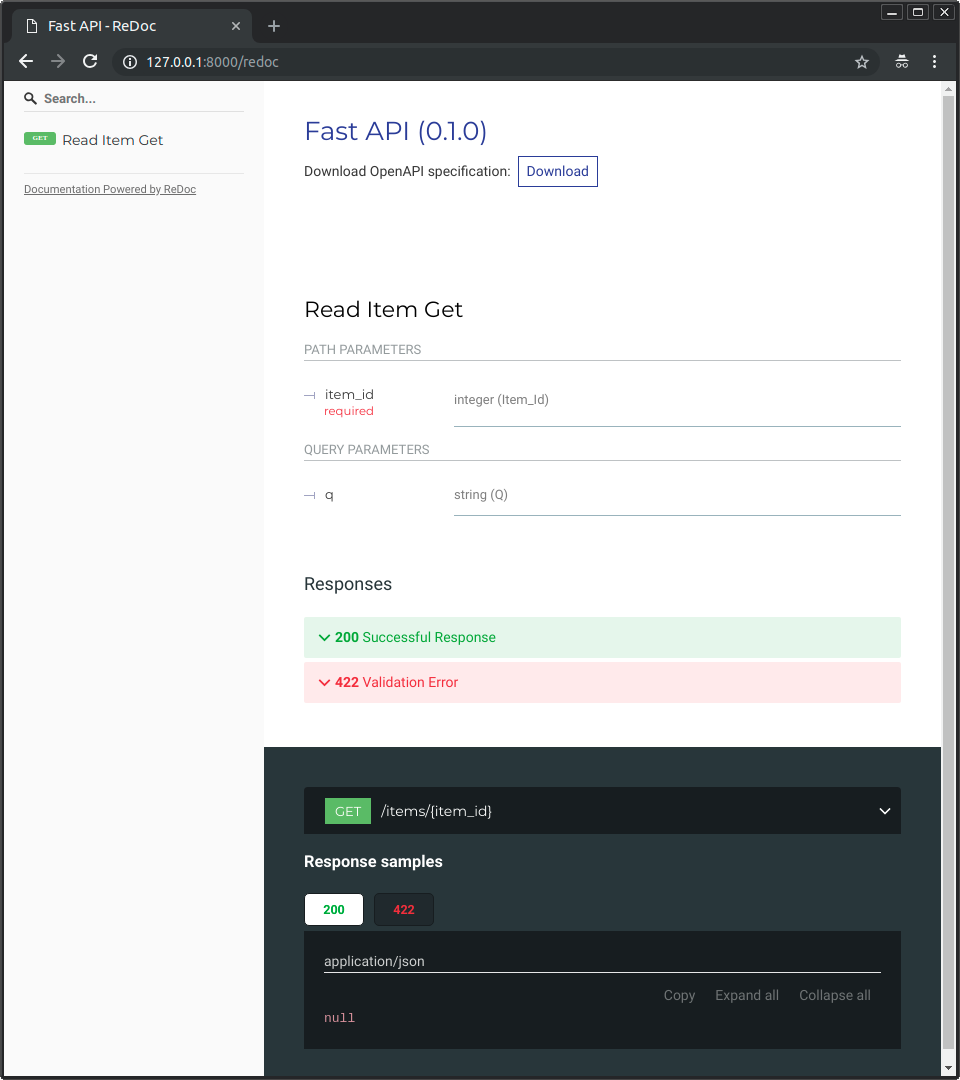 ## Build a Docker Image with a Single-File FastAPI { #build-a-docker-image-with-a-single-file-fastapi } If your FastAPI is a single file, for example, `main.py` without an `./app` directory, your file structure could look like this: ``` .Created: Sun Dec 28 07:19:09 GMT 2025 - Last Modified: Sat Sep 20 12:58:04 GMT 2025 - 29.5K bytes - Click Count (1) -
docs_src/additional_responses/tutorial004_py39.py
from typing import Union

from fastapi import FastAPI
from fastapi.responses import FileResponse
from pydantic import BaseModel


class Item(BaseModel):
    id: str
    value: str


responses = {
    404: {"description": "Item not found"},
    302: {"description": "The item was moved"},
    403: {"description": "Not enough privileges"},
}


app = FastAPI()


@app.get(
    "/items/{item_id}",
Created: Sun Dec 28 07:19:09 GMT 2025 - Last Modified: Wed Dec 17 20:41:43 GMT 2025 - 701 bytes - Click Count (0) -
docs/zh/docs/index.md
<a href="https://pypi.org/project/fastapi" target="_blank">
    <img src="https://img.shields.io/pypi/pyversions/fastapi.svg?color=%2334D058" alt="Supported Python versions">
</a>
</p>

---

**文档**: <a href="https://fastapi.tiangolo.com" target="_blank">https://fastapi.tiangolo.com</a>

**源码**: <a href="https://github.com/fastapi/fastapi" target="_blank">https://github.com/fastapi/fastapi</a>

---
Created: Sun Dec 28 07:19:09 GMT 2025 - Last Modified: Sat Oct 11 17:48:49 GMT 2025 - 18.2K bytes - Click Count (0)