- Sort Score
- Num 10 results
- Language All
Results 1 - 10 of 1,943 for parameter_ (0.07 seconds)
-
docs/de/docs/index.md
* Beide _Pfade_ nehmen `GET` Operationen (auch bekannt als HTTP-_Methoden_) entgegen.
* Der _Pfad_ `/items/{item_id}` hat einen _Pfad-Parameter_ `item_id`, der ein `int` sein sollte.
* Der _Pfad_ `/items/{item_id}` hat einen optionalen `str`-_Query-Parameter_ `q`.

### Interaktive API-Dokumentation { #interactive-api-docs }

Gehen Sie nun auf [http://127.0.0.1:8000/docs](http://127.0.0.1:8000/docs).
Created: Sun Apr 05 07:19:11 GMT 2026 - Last Modified: Thu Mar 19 17:58:09 GMT 2026 - 23.6K bytes - Click Count (1) -
README.md
* The alternative documentation will also reflect the new query parameter and body: 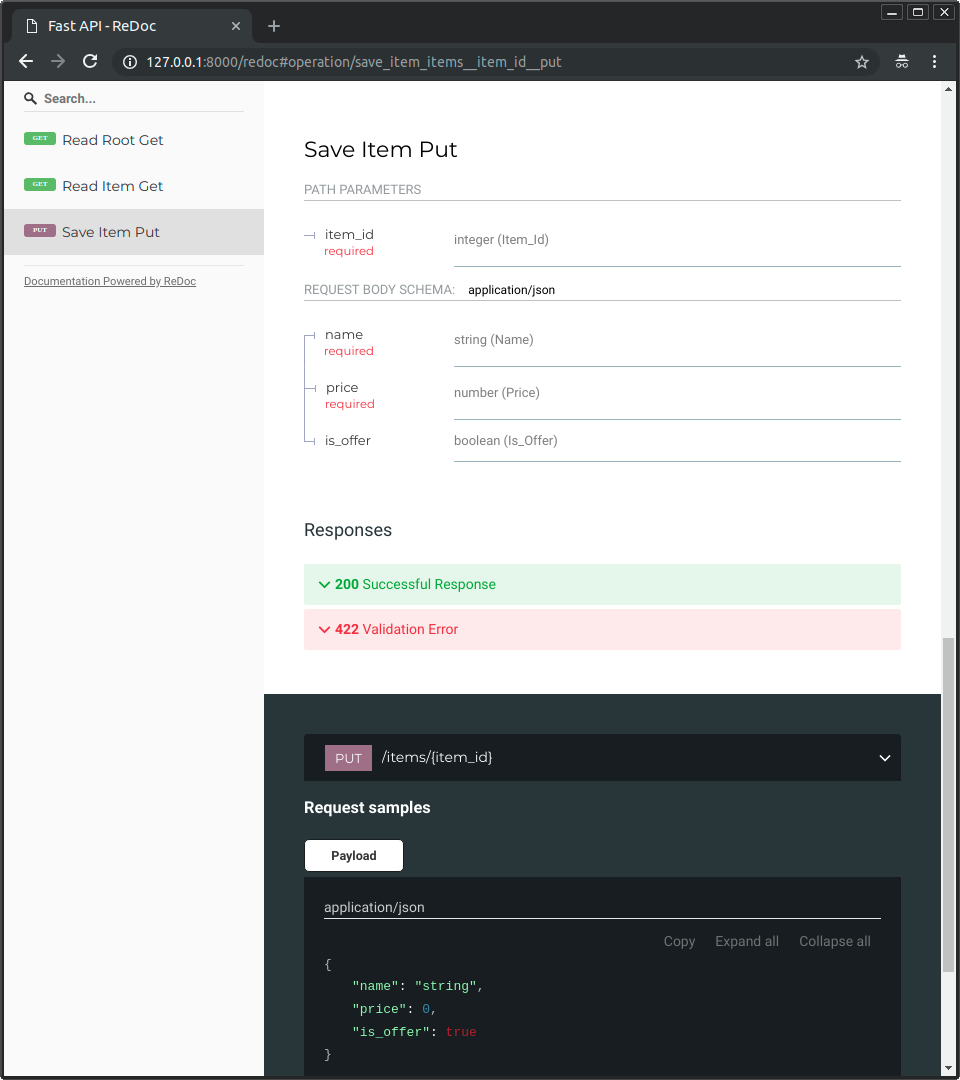 ### Recap In summary, you declare **once** the types of parameters, body, etc. as function parameters. You do that with standard modern Python types.
Created: Sun Apr 05 07:19:11 GMT 2026 - Last Modified: Sat Mar 07 09:29:03 GMT 2026 - 24.3K bytes - Click Count (0) -
docs/tr/docs/index.md
* Her iki _path_ de `GET` operasyonlarını (HTTP _method_'ları olarak da bilinir) kabul eder.
* `/items/{item_id}` _path_'i, `int` olması gereken `item_id` adlı bir _path parameter_'a sahiptir.
* `/items/{item_id}` _path_'i, opsiyonel `str` bir _query parameter_ olan `q`'ya sahiptir.

### Etkileşimli API dokümantasyonu { #interactive-api-docs }

Şimdi [http://127.0.0.1:8000/docs](http://127.0.0.1:8000/docs) adresine gidin.
Created: Sun Apr 05 07:19:11 GMT 2026 - Last Modified: Fri Mar 20 07:53:17 GMT 2026 - 23.2K bytes - Click Count (0) -
docs/en/docs/index.md
* The alternative documentation will also reflect the new query parameter and body:  ### Recap { #recap } In summary, you declare **once** the types of parameters, body, etc. as function parameters. You do that with standard modern Python types.Created: Sun Apr 05 07:19:11 GMT 2026 - Last Modified: Sat Mar 07 09:29:03 GMT 2026 - 21.4K bytes - Click Count (0) -
api/maven-api-core/src/main/java/org/apache/maven/api/plugin/annotations/Parameter.java
     */
    @Nonnull
    String defaultValue() default "";

    /**
     * is the parameter required?
     * @return <code>true</code> if the Mojo should fail when the parameter cannot be injected
     */
    boolean required() default false;

    /**
     * Specifies that this parameter cannot be configured directly by the user (as in the case of POM-specified
Created: Sun Apr 05 03:35:12 GMT 2026 - Last Modified: Mon Feb 05 09:45:47 GMT 2024 - 3.8K bytes - Click Count (0) -
docs/en/docs/reference/parameters.md
# Request Parameters

Here's the reference information for the request parameters.

These are the special functions that you can put in *path operation function* parameters or dependency functions with `Annotated` to get data from the request.

It includes:

* `Query()`
* `Path()`
* `Body()`
* `Cookie()`
* `Header()`
* `Form()`
* `File()`

You can import them all directly from `fastapi`:

```python
Created: Sun Apr 05 07:19:11 GMT 2026 - Last Modified: Thu Apr 18 19:53:19 GMT 2024 - 603 bytes - Click Count (0) -
compat/maven-plugin-api/src/main/java/org/apache/maven/plugin/descriptor/Parameter.java
    }

    /**
     * Creates a shallow copy of this parameter.
     */
    @Override
    public Parameter clone() {
        try {
            return (Parameter) super.clone();
        } catch (CloneNotSupportedException e) {
            throw new UnsupportedOperationException(e);
        }
    }

    public org.apache.maven.api.plugin.descriptor.Parameter getParameterV4() {
Created: Sun Apr 05 03:35:12 GMT 2026 - Last Modified: Fri Jun 06 14:28:57 GMT 2025 - 5.1K bytes - Click Count (0) -
android/guava/src/com/google/common/reflect/Parameter.java
    A[] cast = (A[]) result;
    return cast;
  }

  @Override
  public boolean equals(@Nullable Object obj) {
    if (obj instanceof Parameter) {
      Parameter that = (Parameter) obj;
      return position == that.position && declaration.equals(that.declaration);
    }
    return false;
  }

  @Override
  public int hashCode() {
    return position;
  }
Created: Fri Apr 03 12:43:13 GMT 2026 - Last Modified: Sat Jan 18 02:54:30 GMT 2025 - 4.2K bytes - Click Count (0) -
docs/fr/docs/tutorial/query-params-str-validations.md
# Paramètres de requête et validations de chaînes de caractères { #query-parameters-and-string-validations }

**FastAPI** vous permet de déclarer des informations et des validations supplémentaires pour vos paramètres.

Prenons cette application comme exemple :

{* ../../docs_src/query_params_str_validations/tutorial001_py310.py hl[7] *}
Created: Sun Apr 05 07:19:11 GMT 2026 - Last Modified: Thu Mar 19 18:37:13 GMT 2026 - 19K bytes - Click Count (0) -
docs/fr/docs/tutorial/query-param-models.md
# Modèles de paramètres de requête { #query-parameter-models }

Si vous avez un groupe de paramètres de requête liés, vous pouvez créer un modèle Pydantic pour les déclarer.

Cela vous permet de réutiliser le modèle à plusieurs endroits et aussi de déclarer des validations et des métadonnées pour tous les paramètres en une seule fois. 😎

/// note | Remarque

Pris en charge depuis FastAPI version `0.115.0`. 🤓

///
Created: Sun Apr 05 07:19:11 GMT 2026 - Last Modified: Sat Feb 14 08:12:41 GMT 2026 - 2.5K bytes - Click Count (0)